

 Beyond Silicon: Thin Film Photovoltaics 2023-2033シリコンの向こう側:薄膜太陽電池 2023-2033年 この調査レポートでは、薄膜太陽電池の技術パフォーマンス、サプライチェーン、製造ノウハウ、アプリケーション開発の進捗状況などの現状と最新動向について詳細に調査・分析しています。 ... もっと見る

出版社
IDTechEx
アイディーテックエックス 出版年月
2022年8月22日
価格
お問い合わせください
ライセンス・価格情報/注文方法はこちら 納期
お問合わせください
ページ数
330
言語
英語
※価格はデータリソースまでお問い合わせください。
Summary
この調査レポートでは、薄膜太陽電池の技術パフォーマンス、サプライチェーン、製造ノウハウ、アプリケーション開発の進捗状況などの現状と最新動向について詳細に調査・分析しています。
主な掲載内容(目次より抜粋)
Report Summary
The future of solar technology extends far beyond silicon, with numerous alternative materials that belong to a certain class called 'thin film'. These can deliver several unique advantages such as higher efficiency indoor energy harvesting, simpler manufacturing, and potentially lower costs than conventional silicon PV. A particularly exciting opportunity is their role in powering Internet of Things devices - a rapidly growing market following the increasing smartification of home and retail electronics.
Decarbonization of global energy sources is being catapulted forward as both nations and industries race to achieve net zero, with photovoltaics (PV) already the fastest growing technology. While silicon PV is affordable to consumers and delivers high efficiencies, its application range is limited by its weight, size, and rigidity as well as a complicated manufacturing process. Thin film alternatives present numerous advantages to overcome these limitations and cater to emerging applications such as indoor energy harvesting.
Photovoltaics diversifying into emerging markets
The thin film PV market share has been steady at 5% of annual PV production for the past few years. However, the market is forecast to grow at a CAGR of 10% over the next 10 years. Firstly, there have been improvements in silicon PV alternatives, with efficiencies increasing gradually and manufacturing processes becoming cheaper and more streamlined. Secondly, new applications are being developed that conventional silicon PV is not suitable for due to its rigidity, bulk, and weight. These applications include building integrated PV (BIPV), where the panels are attached to sides of buildings. In many cases, thin film PV panels can be up to 90% lighter than silicon panels and therefore are particularly suitable for applications where weight is an important factor, such as on building façades or weak structures. Some types of thin film PV can be made semi-transparent, which makes them less aesthetically obtrusive and ideally suited to deployment on windows.
Other emerging applications belong to the small self-powered electronics and Internet of Things (IoT) sector, which is expected to grow substantially in the coming years as 'smart' electronics become more prevalent in everyday life. Lightweight thin film minimodules can be used to power such devices and could serve as a cheaper and more long-lasting alternative to batteries or extensive wiring. Many household and retail appliances such as temperature, humidity, motion, and security sensors are likely to become increasingly 'smart' over the next decade and able to transmit data to the cloud to enable greater functionality. This is often referred to as the Internet of Things (IoT) and represents a substantial opportunity for thin film PV.
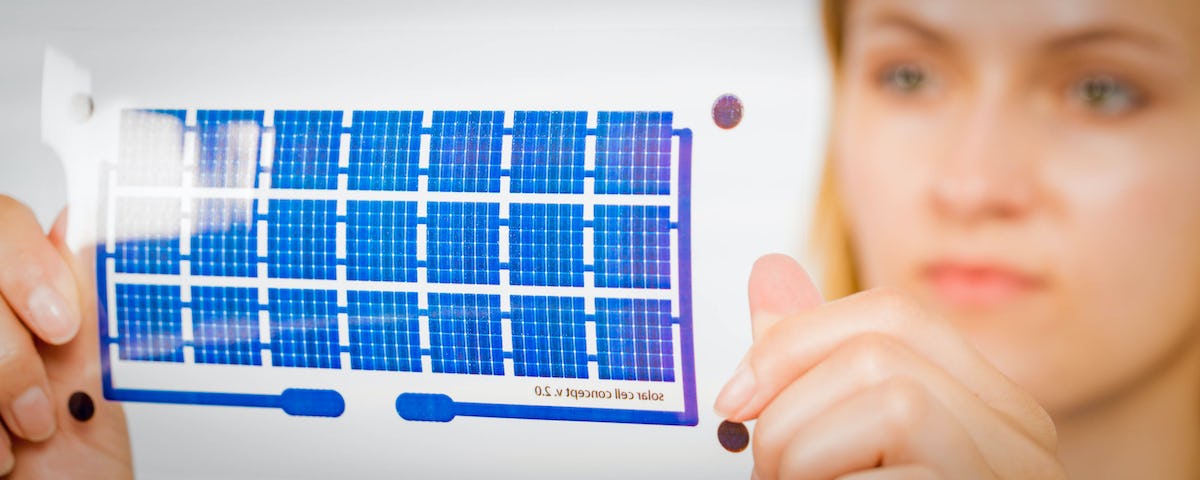
Emerging thin film photovoltaics can be printed onto lightweight flexible substrates
What will dominate the thin film market?
Currently, the thin film market is dominated by cadmium telluride (CdTe), followed in second place by copper indium gallium selenide (CIGS). CdTe is best known in the USA where it is used for 40% of all utility-scale PV power. Despite concerns over the use of the scarce element tellurium, the CdTe market is expected to keep its position following strong investment and the creation of recovery and recycling initiatives that are at present already operative.
CIGS technology on the other hand has been plagued by commercial failures, with the largest manufacturer having exited the market in June 2022. It is expected that CIGS will be surpassed in the coming years by perovskite PV - a very young and exciting technology that has shown remarkable efficiency gains in just a few years, with record efficiencies already on par with those of silicon PV, a technology with decades of research behind it. Perovskite PV is well-suited to both outdoor high power density applications as well as indoor energy harvesting and powering small electronics. Perovskite PV does not use toxic or rare materials, and the manufacturing is well-suited to scalable solution-based deposition methods. Despite all these benefits of perovskite PV, concerns over long-term durability have raised a lot of questions regarding their imminent commercialization.
Organic PV is another contender in this area and is already commercial on a small scale in both outdoor and indoor applications. Given the short lifespans of organic solar cells, typically 5 years, they are better to suited to powering short-term use electronics rather than large area outdoor energy harvesting that are expected to last > 15 years. For this reason, the application range of organic PV is limited. Another thin film PV technology is dye sensitized solar cells (DSSCs). DSSCs have been studied for decades; however, commercial traction is relatively recent. It is now possible to buy wireless headphones and smart helmets powered by DSSCs. Adidas is working to incorporate DSSCs into their own headphone line in the future. Similarly to organic PV, DSSCs do not have long lifespans and therefore their application range is also limited to short-term use electronics.
Outlook
The thin film PV market is set to grow to US$ 6.1 billion by 2033. This follows significant expansion of cadmium telluride PV into both rooftop and solar farms markets as well as the burgeoning commercialization of perovskite PV. Perovskite PV is being developed for large outdoor installations but is also a very promising technology for indoor energy harvesting and powering small electronic devices and Internet of Things - these are markets that are set to grow rapidly in coming years as 'smart' technology becomes widespread. Along with the growth of these technologies comes substantial innovation and materials opportunities. Solar cells are increasingly being developed on flexible metal foils and plastic films, and their long-term durability requires high quality encapsulation. Optimizing materials to meet emerging applications and consumer demand is a compelling market opportunity.
Key questions answered in this report
IDTechEx has 10 years of expertise covering printed and flexible electronics, including thin film photovoltaics. Our analysts have closely followed the latest developments in the technology and associated markets, interviewed key players across the supply chain, attended conferences, and delivered consulting projects on the field. This report examines the current status and latest trends in technology performance, supply chain, manufacturing know-how, and application development progress. It also identifies the key challenges, competition and innovation opportunities facing thin film photovoltaics.
Table of Contents
株式会社 データリソース Data Resource, Inc.
電話:03-3582-2531
COPYRIGHT(C) 2011-2025 DATA RESOURCE, Inc. ALL RIGHTS RESERVED. |


