 ヒューマノイドロボット 2026-2036:技術、市場、そして機会Humanoid Robots 2026-2036: Technologies, Markets, and Opportunities 自動車産業、物流、家庭用、主要プレイヤーとサプライヤー、AIチップ、バッテリー、アクチュエーター、モーター、ネジ、触覚センサー、カメラ、ベアリング、LiDAR、PEEK材料、部品コスト分析、10年間の数量と... もっと見る


サマリー自動車産業、物流、家庭用、主要プレイヤーとサプライヤー、AIチップ、バッテリー、アクチュエーター、モーター、ネジ、触覚センサー、カメラ、ベアリング、LiDAR、PEEK材料、部品コスト分析、10年間の数量と市場規模予測 ヒューマノイドロボットは、未来的なプロトタイプというよりも、具現化されたAIの進歩、より高性能な電気機械ハードウェア、労働力不足産業における柔軟な自動化への需要拡大により、人工知能を人間が設計した環境に導入する具体的な手段として捉えられるようになってきている。 過去12か月間、活動は展示会でのデモンストレーションから、生産現場での構造化されたパイロット試験へと移行している。これはベンチャー支援スタートアップと確立されたOEM双方の、より大規模で計画的な投資によって支えられている。部品サプライチェーンが徐々に安定し、初期段階のコスト削減が進む中、運用者は実際の導入データを活用し、近未来においてヒューマノイドが実用可能な領域とそうでない領域を定義し始めている。
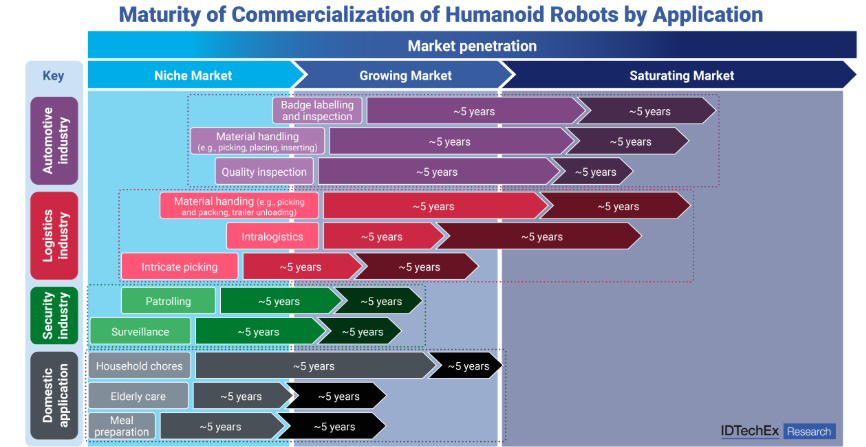
用途別ヒューマノイドロボット商業化の成熟度。詳細データはIDTechEx調査報告書「Humanoid Robots 2026-2036: Technology, Market, and Opportunities」を参照
IDTechExレポート「ヒューマノイドロボット2026-2036:技術・市場・機会」は、部品レベルでのヒューマノイドロボットに関する詳細な技術的・商業的評価を提供する。 アクチュエータ、モーター、減速機、ねじ、ベアリング、カメラ、LiDAR、レーダー、超音波センサー、触覚センサー、ソフトウェアおよびAIスタック、バッテリー、熱管理、高性能材料、エンドエフェクタを網羅。設計・製造上の課題、コスト削減の可能性、サプライチェーンの制約、主要産業における現実的な導入経路を評価。
レポートの主な見解
産業導入:自動車と物流が最初の拡大市場
IDTechExは、自動車製造がヒューマノイドロボット導入を拡大する最初の市場セグメントになると予測する。これは、OEMからの強力な戦略的支援、制御された運用環境、反復的な労働集約的タスクに対する明確なROIの正当化によって推進される。初期導入は、材料搬送、検査支援、工場内輸送、単純な組立支援など、基本的だが拡張可能なタスクに焦点を当てており、「汎用」能力よりも信頼性、安全性検証、保守性に重点が置かれている。
物流・倉庫分野での導入はその後続くと予想されるが、AMR(自律移動ロボット)、AGV(無人搬送車)、ロボットアームといった既存自動化ソリューションとの競合により成長は緩やかになる可能性がある。しかし、人間を中心に設計された環境で混合タスクが要求される場面では、ヒューマノイドロボットが柔軟な代替手段として位置づけられるケースが増加している。ハードウェアコストの低下とタスク性能の向上に伴い、基本的なピックアンドプレイス、小包処理、反復的な倉庫作業フローにおいて、ヒューマノイドロボットは商業的に魅力ある選択肢となり得る。
家庭用ヒューマノイドロボットは依然として長期的な機会である。2026年から2036年の予測期間内では普及が限定的と予想されるものの、IDTechExは安全・手頃な価格・信頼性の障壁が克服されれば、潜在的な長期需要規模からこの分野が戦略的に重要であり続けると見ている。
部品レベルの課題:コスト、信頼性、サプライチェーンのボトルネック
市場勢いが加速しているにもかかわらず、ヒューマノイドロボットは依然として重大な設計・製造上の制約に直面している。主なボトルネックには、稼働時間を制限しダウンタイムを増加させる電池エネルギー密度と熱管理の限界が含まれる。同時に、ネジ、ベアリング、高性能アクチュエータなどの高精度部品の量産化は、現行のサプライチェーンが大量生産向けの最適化をまだ達成していないため、依然として重大な課題である。
器用なハンドと触覚センシングも、単純な産業作業を超えたヒューマノイドのタスク能力拡大における主要な障壁である。本レポートはエンドエフェクタ設計の現状、触覚センサーの成熟度、ソフトウェア統合要件を評価し、商業規模化が最も有望な技術的道筋を明らかにする。
結論
ヒューマノイドロボットは、誇大宣伝に支えられたプロトタイプ段階から初期商業展開へと移行しつつあり、自動車製造が最初の拡張可能な導入市場として浮上している。コスト低下と性能向上が進むにつれ、物流・倉庫業がこれに続く見込みであり、家庭用はより長期的な戦略的需要ドライバーとして位置づけられる。具現化されたAIの継続的進歩とハードウェアコスト削減により、IDTechExはヒューマノイドロボット市場が2036年までに約295億米ドルに達すると予測している。
主要な側面
本レポートは、ヒューマノイドロボットの主要用途と各構成要素の技術的・規制的・商業的課題に焦点を当てた重要な市場情報を提供する。内容は以下の通り:
最先端ヒューマノイドロボットの現状、対象産業、導入スケジュールに関するレビュー:
ヒューマノイドロボットの各ハードウェア構成要素の完全分析:
市場規模予測とビジネスチャンス:
目次
1. エグゼクティブサマリー
1.1. 2026年におけるヒューマノイドロボットの課題と動向
1.2. 部品選定 - コスト効率が鍵となるか?
1.3. 部品の動向 - モジュール化、高効率材料、電力効率
1.4. 動向:量産規模拡大とタスク特化によるコスト削減
1.5. ヒューマノイドロボットの総括
1.6. 用途別ヒューマノイドロボットの商用化成熟度
1.7. ヒューマノイドロボットの重要部品総括
1.8. アクチュエータ - 技術比較と課題
1.9. 2026年におけるモーターの総括
1.10. 減速機のベンチマーク
1.11. 周辺環境を感知する3D視覚システム
1.12. 技術別触覚センサーのベンチマーク
1.13. 部品別コスト分析
1.14. ソフトウェアと機能の概要
1.15. 国別・主要用途別ヒューマノイド市場
1.16. 物流業界におけるヒューマノイドロボットの利点と課題
1.17. 物流業界でヒューマノイドロボットが処理するタスクの推定タイムライン
1.18. 自動車産業におけるヒューマノイドロボットのタスク:確立済みアプリケーションと新興アプリケーションの比較
1.19. BYDとテスラによるヒューマノイド導入の野心的な目標
1.20. 自動車産業におけるヒューマノイドロボットの技術的課題
1.21. 自動車産業におけるヒューマノイドの商業的・規制的課題
1.22. 自動車・物流・家庭用産業におけるヒューマノイドロボットの市場規模と数量予測
1.23. 産業用ヒューマノイドロボット向けバッテリー容量(MWh)予測:2026-2036年
1.24. ヒューマノイドロボットハードウェア部品数量予測:2026-2036年
1.25. ヒューマノイドロボットハードウェア部品市場規模予測:2026-2036年
2. はじめに
2.1. ヒューマノイドロボットの概要
2.2. なぜヒューマノイドロボットなのか、そしてヒューマノイドロボットと特殊ロボットの違いは?
2.3. ヒューマノイドロボットの採用を加速させている要因は?
2.4. ヒューマノイドロボットの採用を妨げる要因は?
2.5. 産業
5.0 とは?
2.6. ヒューマノイドロボットに対する長期的な野望? イーロン・マスクとテスラによる背景
2.7. 急成長するヒューマノイドロボット産業
2.8. 主要企業がヒューマノイドロボット分野に参入
2.9. Cosmos と Nvidia の Isaac GR00T
2.10. 自動車産業とヒューマノイドロボット産業の相乗効果
2.11. コスト分析 - Optimus (1/2)
2.12. コスト分析 - Optimus (2/2)
2.13. パートナーシップと採用
3. 主要顧客とユースケース
3.1. 概要
3.1.1. ヒューマノイドロボットを採用する可能性が最も高い分野 (1/2)
3.1.2. ヒューマノイドロボットを採用する可能性が最も高い分野 (2/2)
3.1.3. 国別・主要ユースケース別ヒューマノイド市場
3.1.4. 用途別ヒューマノイドロボットの商用化成熟度
3.1.5. ヒューマノイドロボットのまとめ(1/3)
3.1.6. ヒューマノイドロボットのまとめ(2/3)
3.1.7. ヒューマノイドロボットのまとめ(3/3)
3.2. 自動車産業
3.2.1. 自動車産業 - 協業事例(1/3)
3.2.2. 自動車産業 - 協業事例(2/3)
3.2.3. 自動車産業 - 協業事例(3/3)
3.2.4. ヒューマノイドロボットと自動車OEMメーカー(1/2)
3.2.5. ヒューマノイドロボットと自動車OEMメーカー(2/2)
3.2.6. 自動車産業におけるヒューマノイドロボットの役割
3.2.7. 自動車産業 - BYDにおけるUBTech製ヒューマノイドの資材運搬活用
3.2.8. 自動車産業 - Nioが工場でUBTech製ヒューマノイドを用いたパイロット操業を実施
3.2.9. ZeekrもNioに続き自社工場にUBTech製ヒューマノイドを導入
3.2.10. Figure AIのFigure 02がBMWと協業
3.2.11. ApptronikのApolloがメルセデス・ベンツと協業
3.2.12. 自動車産業におけるヒューマノイドロボットのタスク:確立された用途 vs 新興用途
3.2.13. BYDとTeslaによるヒューマノイド導入の野心的な目標
3.2.14. 自動車産業におけるヒューマノイドロボットの技術的課題
3.2.15. 自動車産業におけるヒューマノイドの商業的および規制上の課題
3.2.16. 自動車産業におけるヒューマノイドの機会
3.3. 物流業界
3.3.1. 物流業界におけるヒューマノイドロボットの概要 (1)
3.3.2. 物流業界におけるヒューマノイドロボットの概要 (2)
3.3.3. 物流業界におけるヒューマノイドロボットのメリットと課題
3.3.4. Agility Robotics - 物流業界をリードするヒューマノイドロボットメーカー
3.3.5. 倉庫で使用されるヒューマノイドロボットの協力領域 - 安全上の課題
3.3.6. BYD - UBTech のヒューマノイドロボットによるラストマイル配送
3.3.7. GXO と Apptronik
3.3.8. Figure の Helix:物流におけるヒューマノイドロボット
3.3.9. ヒューマノイド × シーメンス:産業物流業務で実証された車輪付きヒューマノイドロボット
3.3.10. 物流業界におけるヒューマノイドロボットが扱うタスクの推定タイムライン
3.4. ヒューマノイドロボット業界に関するニュースと主要企業
3.4.1. メタがヒューマノイドロボット分野に参入
3.4.2. Figure AI:家庭環境で実証された技術
3.4.3. Nvidiaの人型ロボット技術
3.4.4. CosmosとNvidiaのIsaac GR00T
3.4.5. ApptronikがシリーズAで3億5000万ドルを調達
4. 設計、製造、商業化の課題
4.1. 課題の概要
4.1.1. 設計および製造上の課題 (1/3) - 概要
4.1.2. 設計および製造上の課題 (2/3) - 概要
4.1.3. 設計および製造上の課題 (3/3) - 概要
4.1.4. ヒューマノイドロボット導入における商業的および社会的障壁
4.1.5. ヒューマノイドロボット統合に関する課題
4.1.6. UniTree
4.1.7. Manus - モーションキャプチャ用手追跡用 MetaGloves
4.2. 設計および製造上の課題
4.2.1. 設計および製造上の課題 - アクチュエータ(モーター + 減速機)
4.2.2. 設計および製造上の課題 - 減速機
4.2.3. 設計・製造上の課題 - モーターと熱管理(1/2)
4.2.4.設計・製造上の課題 - モーターと熱管理(2/2)
4.2.5.設計・製造上の課題 - バッテリーと冷却
4.2.6.設計、製造、商業上の課題 - 触覚センサー
4.3.規制と商業上の課題
4.3.1. 懸念事項:安全性、規制、データプライバシー
4.3.2. 安全性と規制要件の回避方法 - 産業環境における協調空間
4.3.3. 投資収益率を証明する十分な証拠の欠如
4.3.4. ヒューマノイドロボットに関する地域規制
4.3.5. ヒューマノイドロボットに関する地域規制
4.3.6. ヒューマノイドロボットに関する地域規制
4.3.7. ヒューマノイドロボットに関する地域規制
4.3.8. ヒューマノイドロボットに関する地域規制 - その他の主要管轄区域
4.3.9. ヒューマノイドロボット導入スケジュールに対する規制上の影響
5. コンポーネントレベル分析
5.1. 概要
5.1.1. ヒューマノイドモデルのコンポーネント概要
5.1.2. ヒューマノイドロボットの重要コンポーネント概要
5.1.3. 構成部品別コスト分析
5.1.4. 構成部品概要 - Tesla Optimus
5.2. アクチュエータ概要
5.2.1. アクチュエータ - 導入
5.2.2. アクチュエータ - 構成部品レベルでの区分
5.2.3. アクチュエータの分類:直線型と回転型
5.2.4. 直線型と回転型アクチュエータの長所と短所
5.2.5. 直線型と回転型アクチュエータとヒューマノイドの関節におけるそれらの応用
5.2.6. アクチュエータの分類:電気式、空気圧式、油圧式
5.2.7. アクチュエータ - 技術的比較と課題
5.2.8. 駆動:ダイレクトドライブかギアード設定か?
5.3. モーター
5.3.1. 電気モーターの普及拡大
5.3.2. 主要ヒューマノイドロボット企業別モーター概要
5.3.3. ダイレクトドライブモーター - フレームレスモーター
5.3.4. フレームレスモーター - ダイレクトドライブアクチュエータまたはギア駆動に適用可能
5.3.5. ブラシ付き/ブラシレスモーター
5.3.6. コアレスモーター
5.3.7. コアレスモーターの長所と短所
5.3.8. モーター - ハウジングとケーシング:現行および新興材料
5.3.9. BLDCモーターハウジングの表面処理
5.3.10. 2026年のモーター概要
5.3.11. ユースケース:テスラ・オプティマスモーター
5.4. 減速機
5.4.1. 減速機の概要:ハーモニック減速機、遊星減速機、RV減速機
5.4.2. 減速機のベンチマーク(1/2)
5.4.3. 減速機のベンチマーク(2/2)
5.4.4. ハーモニック減速機
5.4.5. ハーモニック減速機の設計、製造、材料に関する課題
5.4.6. RV減速機
5.4.7. RV減速機の設計、製造、材料に関する課題
5.4.8. 遊星減速機
5.4.9. 遊星減速機の熱管理に関する課題
5.4.10. 遊星減速機の設計と製造に関する課題
5.4.11. 使用事例:テスラ・オプティマス
5.5. ねじ
5.5.1. 各種ねじの概要
5.5.2. ボールねじ - 構成部品と技術分析(1/2)
5.5.3. ボールねじ - 構成部品と技術分析(2/2)
5.5.4. プラネタリローラーねじ - 概要と主要構成部品
5.5.5. 遊星ローラースクリューの長所と短所
5.5.6. 遊星ローラースクリューの課題:大規模かつ高品質な製造
5.5.7. 遊星ローラースクリューの材料に関する考慮事項
5.5.8. 表面コーティングおよび処理部品
5.5.9. 金属部品の熱処理
5.5.10. テスラ・オプティマス:ローラースクリューとボールスクリュー
5.5.11. ヒューマノイドロボットの伝動システム向け材料例
5.5.12. ヘビーデューティ用途向けねじの将来動向
5.6. ベアリング
5.6.1. ベアリングの概要
5.6.2. ベアリングの分類
5.6.3. ボールベアリングとローラーベアリングの比較
5.6.4. 構造部品と外装材
5.6.5. まとめ
5.6.6. 部品表の概要 - ヒューマノイド用フレーム、関節、表面
5.6.7. ヒューマノイドロボットのフレームと関節の主要材料と表面処理の比較 (1/2)
5.6.8. ヒューマノイドロボットのフレームと関節の主要材料と表面処理の比較 (2/2)
5.6.9. マグネシウム対アルミニウム合金
5.6.10. ヒューマノイド骨格の技術要件 - 軽量金属構造材料 - マグネシウム
5.6.11. 構造材料としてのマグネシウム合金使用の課題 - 表面処理
5.6.12. ヒューマノイド用スキン
5.6.13. 1X Robotics - スキン材料としてのPA66
5.6.14. XPeng - IRON - FAM
5.6.15. ヒューマノイド外殻およびフレーム材料の表面処理
5.6.16. 各種ヒューマノイド部品の部品表(BOM)(1/2)
5.6.17. 各種ヒューマノイド部品の部品表(BOM)(2/2)
5.7. センサー - カメラ、LiDAR、レーダー、超音波センサー
5.7.1. 周囲を感知する3D視覚システム
5.7.2. ユースケース:UBTechのWalker S1(マルチカメラ搭載)
5.7.3. ユースケース:UBTechのWalker X(マルチカメラと超音波センサー搭載)
5.7.4. ユースケース:Boston Dynamics - LiDAR、深度センサー、RGBカメラ
5.7.5.カメラのみか、LiDAR + カメラソリューションか?
5.7.6.展望:ヒューマノイドロボットにおけるカメラとLiDAR
5.7.7. LiDAR、カメラ、1D/3D超音波センサーの比較
5.7.8. LiDAR、カメラ、超音波センサーの比較 - (1)
5.7.9. LiDAR、カメラ、超音波センサーの比較 - (2)
5.7.10. ヒューマノイドロボット用途におけるLiDARのコストと技術分析
5.7.11. ヒューマノイドにおけるLiDARの必要性と分類
5.7.12. LiDARコスト内訳と走査方式
5.7.13. ミリ波レーダー
5.8. 触覚センサー
5.8.1. 触覚センサー - センサー基盤技術の概要
5.8.2. 触覚センサー - ヒューマノイドロボット向け高付加価値部品
5.8.3. 技術別触覚センサー比較評価
5.8.4. ユースケース:Sanctuary.AIの汎用ロボットPhoenixへの触覚センサー導入
5.8.5. ユースケース:TeslaのOptimusへの6D触覚/力センサー導入
5.8.6. Paxini - ヒューマノイドロボット指用触覚センサー
5.8.7. 従来型触覚センサーとの比較
5.8.8. Unitree社によるNexdor及びHanwei社製触覚センサーの採用
5.8.9. Gelsight - Digit: 手用カメラベース触覚センサー
5.8.10. 柔軟性のある触覚センサーが主流となるが、技術的・材料的課題は残る
5.8.11. 手足における触覚センシング
5.8.12. 身体への触覚センシングと電子皮膚
5.8.13. 触覚センサーと電子皮膚の課題
5.8.14. 2026年の触覚センサー概要
5.9. ソフトウェア、AI、チップ
5.9.1. AIハードウェアとソフトウェアの導入
5.9.2. ソフトウェアと機能の概要
5.9.3. ソフトウェア - シミュレーション/トレーニング環境と知覚/センシング
5.9.4. ソフトウェア - モーションプランニングと制御
5.9.5. ソフトウェア - 基盤モデル
5.9.6. トレーニングデータの不足 - AIの課題点 - 合成データ生成
5.9.7. Nvidia Isaac GR00T - 合成データ生成
5.9.8. ヒューマノイドロボット向けマルチコンタクト計画と制御
5.10. 充電用バッテリーとパワーエレクトロニクス
5.10.1. ヒューマノイド用バッテリーのパラメータ比較
5.10.2. 2026年のバッテリー課題
5.10.3. 限られたバッテリー持続時間 - 急速充電またはバッテリー交換 - 熱管理の課題と潜在的な解決策
5.10.4. バッテリー化学
5.10.5. 4時間連続稼働可能な交換式バッテリー
5.10.6. 設計と製造の課題 - バッテリーと冷却
5.10.7. 2026年のヒューマノイド用電池の展望
5.10.8.産業用ヒューマノイドロボット1台あたりの電池容量予測:2025-2045年
5.11.高性能材料
5.11.1.形状記憶合金(SMA)と低融点合金(LMPA)
5.11.2. 軽量ヒューマノイドロボットに向けたマグネシウム合金の動向
5.11.3. マグネシウム合金の技術的課題とホンダのASIMO
5.11.4. PEEK - コストと技術的特性
5.11.5. ヒューマノイドロボット部品におけるPEEKの応用
5.11.6. ヒューマノイドロボットにおけるPEEKの課題と市場見通し(1)
5.11.7. ヒューマノイドロボットにおけるPEEKの課題と市場展望(2)
5.11.8. ヒューマノイドに使用可能な市販PEEK材料
5.11.9. PEEK、アルミニウム、マグネシウム合金の材料性能比較
5.11.10. NdFeB - 希土類永久磁石
5.11.11. 希土類金属は電気自動車で一般的に使用されており、ヒューマノイドロボット産業へのサプライチェーンの相乗効果につながっている
5.11.12. 超高分子量ポリエチレン(UHMWPE)
5.11.13. ヒューマノイドロボット用鋼材 - Optimus における材料タイプ別の推定重量要件
5.11.14. ヒューマノイドロボットの材料選好性概要
5.12. アームエフェクタ
5.12.1. ヒューマノイドアームエフェクタの要点
5.12.2. ホットスワップ可能なアームエフェクタ
5.12.3. 2026年におけるヒューマノイドハンドの技術的障壁
5.12.4. 器用なハンド:中核機能と技術的道筋
5.12.5. ヒューマノイドハンドの駆動方式
5.12.6. コアレスDCモーター-器用な手の「エンジン」
5.12.7. 器用な手向けコアレスDCモーターの競争環境
5.12.8. 光学式エンコーダー:器用な手の精度と安定性を実現
5.12.9. 光ディスクエンコーダの競争環境
5.12.10. 冷却
5.12.11. ヒューマノイドロボットの熱的課題
5.12.12. ヒューマノイドロボットの冷却概要
5.12.13. アクチュエータ:ハウジング上のマイクロ冷却チャネル
5.12.14. ヒューマノイドロボットの関節の空冷
5.12.15.ヒューマノイドロボットにおける液体冷却
5.12.16. 冷却ユースケースの概要(1/2)
5.12.17.冷却ユースケースの概要(2/2)
6. 市場予測と将来動向
6.1.1. 自動車産業におけるヒューマノイドロボットの数量予測:2026-2036 年
6.1.2. 自動車産業におけるヒューマノイドロボットの市場規模予測:2026-2036年
6.1.3. 物流・倉庫産業におけるヒューマノイドロボットの数量予測:2026-2036年
6.1.4. 物流・倉庫産業におけるヒューマノイドロボットの市場規模予測:2026-2036年
6.1.5. 家庭用産業におけるヒューマノイドロボット:2026-2036年
6.1.6. ヒューマノイドロボットのコスト予測:2026-2036年
6.1.7. 産業用ヒューマノイドロボットのバッテリー容量(MWh)予測:2026-2036年
6.1.8. ヒューマノイドロボットハードウェアコンポーネント数量予測:2026-2036年
6.1.9. ヒューマノイドロボットハードウェアコンポーネント市場規模予測:2026-2036年
7. 企業プロファイル
7.1. AgiBot
7.2. Agility Robotics
7.3. 北京ヒューマノイドロボティクスイノベーションセンター
7.4. エポックロボティクス
7.5. フーリエロボティクス
7.6. イントボット
7.7. キノンロボティクス
7.8. マジックアトム
7.9. パルロボティクス
7.10. パシニック知覚技術
7.11. リアルボティックス
7.12. サンクチュアリAI
7.13. シャープロボティクス
7.14. テスラ:ウィー・ロボット サイバーキャブ公開
7.15. テスラ:ウィー・ロボット オプティマス公開
7.16. 優必泰科技
7.17. ユニツリー・ロボティクス
7.18. ユニツリー・ロボティクス:ヒューマノイドロボット
7.19. 星海科技
7.20. 中青

SummaryAutomotive industry, logistics, home-use, key players and suppliers, AI chip, battery, actuator, motor, screw, tactile sensor, camera, bearing, LiDAR, PEEK materials, cost analysis of components, 10-year volume and market size forecast Humanoid robots are increasingly viewed less as futuristic prototypes and more as a concrete way to bring artificial intelligence into human-designed environments, enabled by advances in embodied AI, more capable electromechanical hardware, and growing demand for flexible automation in labor-constrained industries. Over the last 12 months, activity has shifted from trade-show demonstrations to structured pilots on production sites, supported by larger, more deliberate investment from both venture-backed startups and established OEMs. With component supply chains gradually stabilizing and early cost reductions coming through, operators are starting to use real deployment data to define where humanoids are viable, and where they are not, in the near term.
Maturity of commercialization of humanoid robotics by application. For full data, refer to IDTechEx's research on "Humanoid Robots 2026-2036: Technology, Market, and Opportunities"
IDTechEx's report, "Humanoid Robots 2026-2036: Technologies, Markets, and Opportunities", provides a detailed technical and commercial assessment of humanoid robots at the component level. It covers actuators, motors, reducers, screws, bearings, cameras, LiDAR, radar, ultrasonic sensors, tactile sensors, software and AI stacks, batteries, thermal management, high-performance materials, and end effectors. The report evaluates design and manufacturing challenges, cost-down potential, supply chain constraints, and the realistic adoption trajectory across key industries.
Key Insights from the Report
Industrial Adoption: Automotive and Logistics as the First Scaling Markets
IDTechEx expects automotive manufacturing to be the first market segment to scale humanoid robot deployment. This is driven by strong strategic backing from OEMs, controlled operating environments, and clearer ROI justification for repetitive labor-intensive tasks. Early deployments are focused on basic but scalable tasks such as material handling, inspection support, intra-factory transport, and simple assembly assistance, with increasing emphasis on reliability, safety validation, and maintainability rather than "general-purpose" capability.
Logistics and warehousing adoption are expected to follow, although growth may be moderated by competition with existing automation solutions such as AMRs, AGVs, and robotic arms. However, humanoid robots are increasingly positioned as a flexible alternative where mixed tasks are required in environments designed around humans. As hardware cost declines and task performance improves, humanoids could become commercially attractive for basic pick-and-place, parcel handling, and repetitive warehouse workflows.
Home-use humanoid robots remain a longer-term opportunity. While penetration is expected to remain limited within the 2026-2036 forecast window, IDTechEx believes this segment will remain strategically important due to its potential long-term demand scale, once safety, affordability, and reliability barriers are addressed.
Component-Level Challenges: Cost, Reliability, and Supply Chain Bottlenecks
Despite accelerating market momentum, humanoid robots still face major engineering and manufacturing constraints. Key bottlenecks include battery energy density and thermal management limitations, which restrict operating time and increase downtime. At the same time, scaling high-precision components such as screws, bearings, and high-performance actuators remains a critical challenge, as current supply chains are not yet optimized for mass-volume humanoid production.
Dexterous hands and tactile sensing also remain a major hurdle for expanding humanoid task capability beyond simple industrial operations. The report assesses the current state of end effector design, tactile sensor maturity, and software integration requirements, highlighting which technical pathways are most likely to scale commercially.
Conclusion
Humanoid robots are moving beyond hype-driven prototypes toward early commercial deployment, with automotive manufacturing emerging as the first scalable adoption market. Logistics and warehousing are expected to follow as cost declines and performance improves, while home-use remains a longer-term strategic demand driver. With continued progress in embodied AI and hardware cost reduction, IDTechEx forecasts the humanoid robot market will reach ~US$29.5 billion by 2036.
Key Aspects
This report provides critical market intelligence about humanoid robots, focusing on their major applications and each component's technical, regulatory, and commercial challenges. This includes:
A review of state-of-the-art humanoids, their target industries, and adoption timeline:
Full analysis of each hardware component of the humanoid robot:
Market size forecast and business opportunities throughout:
Table of Contents
1. EXECUTIVE SUMMARY
1.1. Pain Points and Trends of Humanoid Robots in 2026
1.2. Choice of components - cost-efficiency is the key?
1.3. Component trend - modularity, efficient materials, and power efficiency
1.4. Trend: Cost Reduction Through Volume Scaling and Task Specialization
1.5. Summary of humanoid robots
1.6. Maturity of commercialization of humanoid robots by application
1.7. Summary of critical components in humanoid robots
1.8. Actuator - technical comparison and challenges
1.9. Summary of motors in 2026
1.10. Benchmarking reducers
1.11. 3D visual systems to sense surroundings
1.12. Benchmarking tactile sensors by technology
1.13. Cost analysis by component
1.14. Summary of software and functions
1.15. Humanoids market by country and primary use-case
1.16. Benefits and challenges of humanoid robots in the logistics industry
1.17. Estimated timeline of tasks handled by humanoid robots in the logistics industry
1.18. Humanoid robot tasks in the automotive industry: Near established vs emerging applications
1.19. Ambitious goals of humanoids deployment from BYD and Tesla
1.20. Technical Challenges for Humanoid Robots in the Automotive Industry
1.21. Commercial and regulatory challenges for humanoids in automotive industry
1.22. Market size and volume forecast of humanoid robots in the automotive, logistics and Home-use industry
1.23. Battery capacity (MWh) forecast for humanoid robots used for industries: 2026-2036
1.24. Humanoid robot hardware component volume forecast: 2026-2036
1.25. Humanoid robot hardware component market size forecast: 2026-2036
2. INTRODUCTION
2.1. Humanoid Robotics Overview
2.2. Why humanoid robots and what is the difference between humanoid robots and specialized robots?
2.3. What is accelerating the adoption of humanoid robots?
2.4. What is holding back the adoption of humanoid robots?
2.5. What is Industry 5.0?
2.6. Over Long-Term Ambitions for Humanoid Robots — Context from Elon Musk and Tesla
2.7. A fast-growing humanoid robotics industry
2.8. Leading players enter the space of humanoid robotics
2.9. Cosmos and Nvidia's Isaac GR00T
2.10. Synergies between automotive industry and humanoid robotics industry
2.11. Cost analysis - Optimus (1/2)
2.12. Cost analysis - Optimus (2/2)
2.13. Partnerships and adoption
3. MAJOR CUSTOMERS AND USE CASES
3.1. Overview
3.1.1. Sectors that most likely to adopt humanoid robot (1/2)
3.1.2. Sectors that most likely to adopt humanoid robot (2/2)
3.1.3. Humanoids market by country and primary use-case
3.1.4. Maturity of commercialization of humanoid robots by application
3.1.5. Summary of humanoid robots (1/3)
3.1.6. Summary of humanoid robots (2/3)
3.1.7. Summary of humanoid robots (3/3)
3.2. Automotive industry
3.2.1. Automotive industry - collaborations (1/3)
3.2.2. Automotive industry - collaborations (2/3)
3.2.3. Automotive industry - collaborations (3/3)
3.2.4. Humanoid robots and automotive OEMs (1/2)
3.2.5. Humanoid robots and automotive OEMs (2/2)
3.2.6. Tasks of humanoid robots in automotive industry
3.2.7. Automotive - UBTech's humanoids used for materials handling at BYD
3.2.8. Automotive - Nio uses UBTech's humanoid doing pilot operation at factories
3.2.9. Zeekr also followed Nio to deploy UBTech's humanoids in their factories
3.2.10. Figure AI's Figure 02 works with BMW
3.2.11. Apptronik's Apollo with Mercedes-Benz
3.2.12. Humanoid Robot Tasks in the Automotive Industry: Near Established vs. Emerging Applications
3.2.13. Ambitious goals of humanoids deployment from BYD and Tesla
3.2.14. Technical Challenges for Humanoid Robots in the Automotive Industry
3.2.15. Commercial and regulatory challenges for humanoids in automotive industry
3.2.16. Opportunities for humanoids in automotive industry
3.3. Logistics industry
3.3.1. Overview of humanoid robots in the logistics industry (1)
3.3.2. Overview of humanoid robots in the logistics industry (2)
3.3.3. Benefits and challenges of humanoid robots in the logistics industry
3.3.4. Agility Robotics - Leading Humanoid Robot Player in the Logistics Industry
3.3.5. Cooperative area for humanoid robots used in warehouses - safety challenge
3.3.6. BYD - UBTech's last mile delivery with humanoid robots
3.3.7. GXO and Apptronik
3.3.8. Figure's Helix: Humanoid Robotics in Logistics
3.3.9. Humanoid × Siemens: Wheeled Humanoid Robots Validated in Industrial Logistics Operations
3.3.10. Estimated timeline of tasks handled by humanoid robots in the logistics industry
3.4. News and players involved in humanoid's robotics industry
3.4.1. Meta getting into humanoid robotics
3.4.2. Figure AI: What Has Been Demonstrated in Home-Like Environments
3.4.3. Nvidia's Humanoid Robot Technologies
3.4.4. Cosmos and Nvidia's Isaac GR00T
3.4.5. Apptronik raised US$350 million in series A funding
4. DESIGN, MANUFACTURING, AND COMMERCIAL CHALLENGES
4.1. Summary of challenges
4.1.1. Design and manufacturing challenges (1/3) - Summary
4.1.2. Design and manufacturing challenges (2/3) - Summary
4.1.3. Design and manufacturing challenges (3/3) - Summary
4.1.4. Commercial and social barriers for adopting humanoid robots
4.1.5. Challenges around humanoid robot integration
4.1.6. UniTree
4.1.7. Manus - MetaGloves for Hand-Tracking for Motion Capture
4.2. Design and manufacturing challenges
4.2.1. Design and manufacturing challenges - actuators (motors + reducers)
4.2.2. Design and manufacturing challenges - reducers
4.2.3. Design and manufacturing challenges - motors and thermal management (1/2)
4.2.4. Design and manufacturing challenges - motors and thermal management (2/2)
4.2.5. Design and manufacturing challenges - batteries and cooling
4.2.6. Design, manufacturing, and commercial challenges - tactile sensors
4.3. Regulatory and commercial challenges
4.3.1. Concerns: Safety, regulation, and data privacy
4.3.2. How to work around safety and regulatory requirement - cooperative space for industrial settings
4.3.3. Lack of enough evidence to prove the return on investment
4.3.4. Regional regulations for humanoid robots
4.3.5. Regional regulations for humanoid robots
4.3.6. Regional regulations for humanoid robots
4.3.7. Regional regulations for humanoid robots
4.3.8. Regional regulations for humanoid robots - Other key jurisdictions
4.3.9. Regulatory implications for humanoid robot deployment timelines
5. COMPONENT LEVEL ANALYSIS
5.1. Overview
5.1.1. Component summary of humanoid models
5.1.2. Summary of critical components in humanoid robots
5.1.3. Cost analysis by component
5.1.4. Component overview - Tesla Optimus
5.2. Actuators Overview
5.2.1. Actuators - introduction
5.2.2. Actuators - componentry level split
5.2.3. Actuators categorization: Linear and rotary
5.2.4. Linear and rotary actuators and their pros and cons
5.2.5. Linear and rotary actuators and their applications in humanoids' joints
5.2.6. Actuator categorization: Electric, pneumatic and hydraulic
5.2.7. Actuator - technical comparison and challenges
5.2.8. Actuation: Direct drive or geared setting?
5.3. Motors
5.3.1. Electric motors are getting increasingly popular
5.3.2. A summary of motors for different humanoid robotics companies
5.3.3. Direct drive motors - frameless motors
5.3.4. Frameless motors - can be used for direct drive actuator or geared actuation
5.3.5. Brushed/Brushless motors
5.3.6. Coreless motors
5.3.7. Benefits and drawbacks of coreless motors
5.3.8. Motors - housing and casing: Current and emerging materials
5.3.9. Surface Processing for BLDC Motor Housings
5.3.10. Summary of motors in 2026
5.3.11. Use case: Tesla Optimus motors
5.4. Reducers
5.4.1. Reducer Overview: Harmonic, Planetary, and RV Reducers
5.4.2. Benchmarking Reducers (1/2)
5.4.3. Benchmarking reducers (2/2)
5.4.4. Harmonic reducer
5.4.5. Design, manufacturing and material challenges of harmonic reducers
5.4.6. RV Reducer
5.4.7. Design, manufacturing and material challenges of RV reducers
5.4.8. Planetary reducer
5.4.9. Thermal management challenges of planetary reducers
5.4.10. Design and manufacturing challenges of planetary reducers
5.4.11. Use cases: Tesla Optimus
5.5. Screws
5.5.1. Introduction to different types of screws
5.5.2. Ball screws - component and technical analysis (1/2)
5.5.3. Ball screws - component and technical analysis (2/2)
5.5.4. Planetary roller screws - introduction and key components
5.5.5. Planetary roller screws benefits and drawbacks
5.5.6. Challenge of planetary roller screws: Manufacturing with high quality at large scale
5.5.7. Material considerations of planetary roller screws
5.5.8. Surface coating and treatment components
5.5.9. Heat Treatment of Metal Components
5.5.10. Tesla Optimus: Roller screws and ball screws
5.5.11. Example materials for humanoid robots' transmission systems
5.5.12. Future trend of screws for heavy-duty tasks
5.6. Bearing
5.6.1. Introduction to bearings
5.6.2. Categorization of bearings
5.6.3. Comparison of ball bearing and roller bearing
5.6.4. Structural components and skin covering materials
5.6.5. Summary
5.6.6. Overview of bill of materials - frames, joints and surfaces for humanoids
5.6.7. Comparison of key materials and surface treatments for humanoid robot frames and joints (1/2)
5.6.8. Comparison of key materials and surface treatments for humanoid robot frames and joints (2/2)
5.6.9. Magnesium versus Aluminum alloy
5.6.10. Humanoids Skeleton Technical Requirements - Lightweight Metal Structural Materials - Magnesium
5.6.11. Challenges of Using Magnesium Alloy as Structural Materials - Surface Treatment
5.6.12. Skins for humanoids
5.6.13. 1X Robotics - PA66 as the Skin Material
5.6.14. XPeng - IRON - FAM
5.6.15. Surface treatment for humanoid shell and frame materials
5.6.16. Bill of materials (BOM) for different humanoid components (1/2)
5.6.17. Bill of materials (BOM) for different humanoid components (2/2)
5.7. Sensors - cameras, LiDAR, radar, and ultrasonic sensors
5.7.1. 3D visual systems to sense the surroundings
5.7.2. Use Case: UBTech's Walker S1 with multi-cameras
5.7.3. Use Case: UBTech's Walker X with multi-cameras and ultrasonic sensors
5.7.4. Use Case: Boston Dynamics - LiDAR, depth sensor and RGB camera
5.7.5. Pure Camera or LiDAR + Camera Solution?
5.7.6. Outlook: Cameras and LiDAR in humanoid robots
5.7.7. Comparison of LiDAR, cameras, and 1D/3D ultrasonic sensors
5.7.8. Comparisons of LiDAR, camera & ultrasonic sensors - (1)
5.7.9. Comparisons of LiDAR, camera & ultrasonic sensors - (2)
5.7.10. LiDAR costs and technical analysis for uses in humanoid robots
5.7.11. Necessity and categorization of LiDAR in humanoids
5.7.12. LiDAR cost breakdown and scanning methods
5.7.13. mmWave Radar
5.8. Tactile Sensors
5.8.1. Tactile sensors - introduction to the technologies behind the sensors
5.8.2. Tactile sensors - high value components for humanoid robotics
5.8.3. Benchmarking tactile sensors by technology
5.8.4. Use Case: Tactile Sensors into Sanctuary.AI's Phoenix General Purpose Robots
5.8.5. Use Case: 6D Tactile/Force Sensors into Tesla's Optimus
5.8.6. Paxini - Tactile sensors for humanoid robot fingers
5.8.7. Comparison of Paxini's tactile sensors with traditional tactile sensors
5.8.8. Unitree uses Nexdor and Hanwei's tactile sensors
5.8.9. Gelsight - Digit: camera-based tactile sensor for hands
5.8.10. Flexible tactile is the trend, however, technical and material challenges remain
5.8.11. Tactile sensing on hands and feet
5.8.12. Tactile sensing and e-skins on body
5.8.13. Challenges of tactile sensors and electronic skins
5.8.14. Summary of tactile sensors in 2026
5.9. Software, AI and Chips
5.9.1. AI hardware and software introduction
5.9.2. Summary of software and functions
5.9.3. Software - Simulation/training environments and perception/sensing
5.9.4. Software - motion planning and control
5.9.5. Software - foundation model
5.9.6. Lack of training data - pain points of AI - synthetic data generation
5.9.7. Nvidia Isaac GR00T - synthetic data generation
5.9.8. Multi-contact planning and control for humanoid robots
5.10. Batteries and power electronics for charging
5.10.1. Humanoid's batteries parameters comparison
5.10.2. Challenges of batteries in 2026
5.10.3. Limited battery endurance - fast charging or battery swapping - thermal management challenges and potential solutions
5.10.4. Battery Chemistry
5.10.5. Swappable battery that runs for four hours continuously
5.10.6. Design and manufacturing challenges - batteries and cooling
5.10.7. Outlook for batteries in humanoids in 2026
5.10.8. Battery capacity per humanoid robot for industrial applications forecast: 2025-2045
5.11. High-performance materials
5.11.1. Shape-Memory Alloys (SMAs) and Low-Melting-Point Alloys (LMPAs)
5.11.2. Magnesium alloy - trend towards lightweight humanoid robot
5.11.3. Technical challenges of magnesium alloy and Honda's ASIMO
5.11.4. PEEK - costs and technical properties
5.11.5. Applications of PEEK in humanoid robot components
5.11.6. Challenges and market outlook for PEEK in humanoid robots (1)
5.11.7. Challenges and market outlook for PEEK in humanoid robots (2)
5.11.8. Commercial PEEK materials that can be used for humanoids
5.11.9. Material performance comparison of PEEK, aluminum and magnesium alloy
5.11.10. NdFeB - rare earth permanent magnets
5.11.11. Rare earth metals are commonly used in electric vehicles, leading to supply chain synergies to humanoid robotics industry
5.11.12. Ultra High Molecular Weight Polyethylene (UHMWPE)
5.11.13. Steel materials for humanoid robots - estimated gravimetric requirement per type of material for Optimus
5.11.14. Summary of material preference for humanoid robot
5.12. Arm Effectors
5.12.1. Key points of humanoid's arm effectors
5.12.2. Hot swappable arm effectors
5.12.3. Technical barriers of humanoid hands in 2026
5.12.4. Dexterous Hand: Core Functions and Technical Pathways
5.12.5. Actuation methods of humanoid hands
5.12.6. Coreless DC Motors-The "Engine" Behind Dexterous Hands
5.12.7. Competitive Landscape of Coreless DC Motors for Dexterous Hands
5.12.8. Optical Encoders: Enabling Precision and Stability in Dexterous Hands
5.12.9. Optical Disc Encoder Competitive Landscape
5.12.10. Cooling
5.12.11. Thermal Challenges of Humanoid Robots
5.12.12. Overview of Cooling for Humanoid Robots
5.12.13. Actuator: Micro-Cooling Channels on the Housing
5.12.14. Air Cooling Humanoid Robot Joints
5.12.15. Liquid Cooling in Humanoid Robots
5.12.16. Summary of Cooling Use Cases (1/2)
5.12.17. Summary of Cooling Use Cases (2/2)
6. MARKET FORECASTS AND FUTURE TRENDS
6.1.1. Volume forecast of humanoid robots in the automotive industry: 2026-2036
6.1.2. Market size forecast of humanoid robots in the automotive industry: 2026-2036
6.1.3. Volume forecast of humanoid robots in the logistics and warehousing industry: 2026-2036
6.1.4. Market size forecast of humanoid robots in the logistics and warehousing industry: 2026-2036
6.1.5. Humanoid robots in the Home-use industry: 2026-2036
6.1.6. Cost forecast of humanoid robots: 2026-2036
6.1.7. Battery capacity (MWh) forecast for humanoid robots used for industries: 2026-2036
6.1.8. Humanoid robot hardware component volume forecast: 2026-2036
6.1.9. Humanoid robot hardware component market size forecast: 2026-2036
7. COMPANY PROFILES
7.1. AgiBot
7.2. Agility Robotics
7.3. Beijing Humanoid Robotics Innovation Center
7.4. Epoch Robotics
7.5. Fourier Robotics
7.6. IntBot
7.7. Keenon Robotics
7.8. Magic Atom
7.9. Pal Robotics
7.10. Pasinic Perception Technology
7.11. Realbotix
7.12. Sanctuary AI
7.13. Sharpa Robotics
7.14. Tesla: We, Robot Cybercab Reveal
7.15. Tesla: We, Robot Optimus Reveal
7.16. Ubtech Robotics
7.17. Unitree Robotics
7.18. Unitree Robotics: Humanoid Robotics
7.19. Xinghaitu
7.20. Zhongqing
ご注文は、お電話またはWEBから承ります。お見積もりの作成もお気軽にご相談ください。本レポートと同分野(エネルギー貯蔵)の最新刊レポート
IDTechEx社の 電池 、エネルギー- Batteries & Energy Storage分野 での最新刊レポート
よくあるご質問IDTechEx社はどのような調査会社ですか?IDTechExはセンサ技術や3D印刷、電気自動車などの先端技術・材料市場を対象に広範かつ詳細な調査を行っています。データリソースはIDTechExの調査レポートおよび委託調査(個別調査)を取り扱う日... もっと見る 調査レポートの納品までの日数はどの程度ですか?在庫のあるものは速納となりますが、平均的には 3-4日と見て下さい。
注文の手続きはどのようになっていますか?1)お客様からの御問い合わせをいただきます。
お支払方法の方法はどのようになっていますか?納品と同時にデータリソース社よりお客様へ請求書(必要に応じて納品書も)を発送いたします。
データリソース社はどのような会社ですか?当社は、世界各国の主要調査会社・レポート出版社と提携し、世界各国の市場調査レポートや技術動向レポートなどを日本国内の企業・公官庁及び教育研究機関に提供しております。
|
|


.png)
.png)