農業ロボット市場 2022-2032年
Agricultural Robotics Market 2022-2032
この調査レポートでは、成長する農業ロボット市場の技術的・商業的分析を行い、主要な応用分野と産業を支える実現技術の両方について考察しています。
主な掲載内容(目次より抜粋)
... もっと見る

|

|
サマリー
この調査レポートでは、成長する農業ロボット市場の技術的・商業的分析を行い、主要な応用分野と産業を支える実現技術の両方について考察しています。
主な掲載内容(目次より抜粋)
-
全体概要
-
はじめに
-
農業用ロボット工学:主要な応用分野
-
テクノロジーの有効化
-
市場要因
-
予測
Report Summary
As agricultural labour becomes increasingly costly and scarce, something exacerbated by the COVID-19 crisis, attention is increasingly turning towards robotics as a key component of agricultural production.
This report from IDTechEx provides a technical and commercial analysis of the growing market for agricultural robotics, considering both the key application areas and enabling technologies underpinning the industry. The report also provides ten-year application-based and regional market forecasts for the future of the agricultural robotics industry.
Agricultural robotics are increasingly attracting interest as a potential solution to the sustainability and labour issues facing global agriculture. In recent years, agricultural labour has steadily become costlier and scarcer, particularly following the border closures and worker travel restrictions in the wake of the COVID-19 pandemic, further squeezing farmers' margins and threatening food security across the world.
Automation could help mitigate this. Over the last decade, advances in robotics technology and artificial intelligence (AI) have made the use of farming robots an increasingly viable option. Across the world, a range of start-ups and established companies are working to develop robotic solutions for a number of agricultural tasks, including weeding, seeding, and harvesting.
Agricultural Robotics 2022-2032, a new report from IDTechEx, provides a comprehensive overview of agricultural robotics, focusing on the key application areas of agricultural robotics, the enabling technologies that are underpinning the growth of the industry, and the market factors that will shape the future of the field. The report also provides a ten-year market forecast for the future of the agricultural robotics industry, broken down by regional market share and by application area, predicting that the global agricultural robotics market will be worth $6.7 billion by 2032.
The IDTechEx report divides the global agricultural robotics industry into eight key application areas: weeding robots, seeding robots, autonomous tractors, autonomous implement carriers and platform robots, robotic harvesting, agricultural drones, milking robots, and other applications of agricultural robots. Key enabling technologies considered include RTK-GPS, LiDAR, artificial intelligence (AI), hyperspectral imaging, end effector technology, and precision spraying technology.
Key questions answered in this report
-
What are the sustainability and labour issues facing global agriculture?
-
What is agricultural robotics?
-
What are the key application areas of agricultural robotics?
-
What are the main technological hurdles facing the agricultural robotics industry?
-
Who are the main players in the field?
-
What are the key business model considerations in developing agricultural robots?
-
How will the global agricultural robotics market evolve over the next decade?
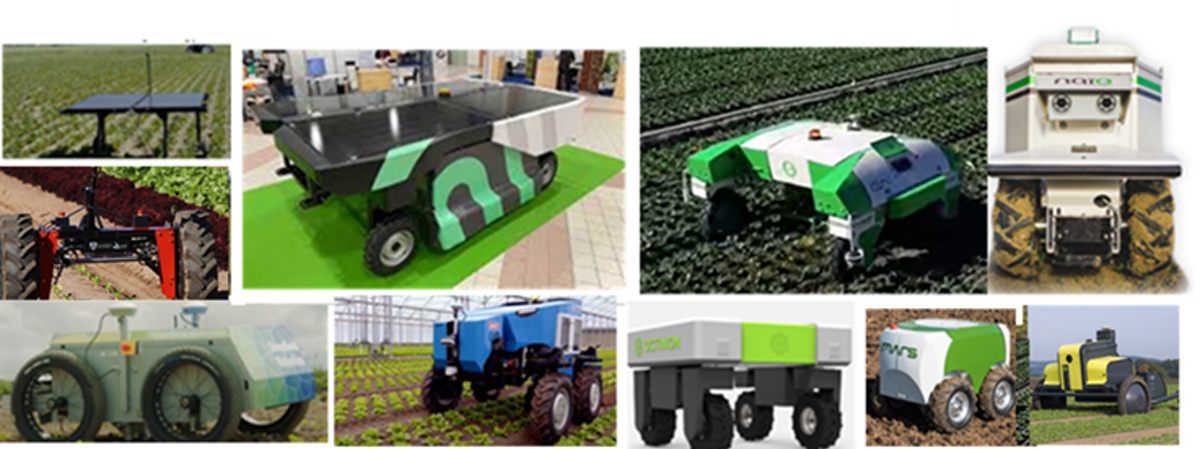
Examples of past and present agricultural robots. Agricultural robots can be used for a variety of tasks including weeding, seeding, and fresh fruit harvesting.
Agricultural robotics: a growing industry enabled by emerging technologies
The day-to-day operation of a farm involves a range of repetitive, time-consuming, and dangerous tasks that could be well suited to automation using robotics. Automation is already widespread in some of these tasks. Robotic milking, for example, is already a billion-dollar industry with a significant percentage of farms in Europe using a form of robotic milking. Agricultural drones are also beginning to find widespread application in imaging and spraying, although regulations continue to limit their usage across much of the world and autonomy of tasks remains somewhat limited. Nevertheless, the market for agricultural drones is expected to show strong growth over much of the next decade.
Other applications are still emerging. Field robots for tasks such as weeding and seeding are entering the early stages of commercialisation. Compared with milking robots, which are stationary robots that generally operate indoors, developing autonomous field robots presents several technical challenges that have historically limited progress. Agricultural environments often feature unpredictable terrain, unknown obstacles, and a range of weather conditions that can impair autonomous navigation and operation and limit reliability. Additionally, agricultural regions are often in highly rural areas, where connectivity and access to repair and maintenance services can be limited.
Despite this, progress is being made and advances in artificial intelligence (AI), computer vision, and positioning technologies have brought field robots closer than ever to commercialisation. Start-ups such as Naïo Technologies, ecoRobotix, and TerraClear have begun commercialising robots for a diverse range of agricultural tasks, while major equipment providers such as John Deere, AGCO, and Kubota have developed autonomous tractor concepts. The Fendt MARS project provided a glimpse into the future of farm robots, using a swarm of small, autonomous robots to carry out tasks usually performed by manned tractors, with the company using the results of this project to develop its Xaver line of agricultural robots. Looking further into the future, companies such as Octinion, Harvest CROO, and FFRobotics are developing robots for harvesting fresh fruit, something that currently involves costly and difficult-to-source labour but is very difficult to replace using robots, requiring a careful balance of computer vision, accurate positioning, and soft-grip technology.
.png)
The rise of agricultural robotics is leading to new value chains emerging.
The growth of the agricultural robotics industry has also led to debate around the best business models, particularly around robotics-as-a-service (RaaS) versus traditional equipment sale. In a robotics-as-a-service model, robots are hired by farms, alongside trained operators, vs. traditional machine/equipment sales. This can help de-risk the operation for farmers, avoiding the need to meet high upfront costs or develop expertise in the technology before deployment. However, it also requires a team of trained operators, which can prevent developers from operating in new geographies and limit scalability. There are also questions around the issue of data ownership and whether data belongs to farmers, data collectors, technology providers, or landowners. Regulations around this have not yet caught up with the pace of technology development and this is a key uncertainty over the future of the agricultural robotics industry.
Developments over the next few years are set to play a pivotal role in the progress of the agricultural robotics industry. Agricultural Robotics 2022-2032, a new report from IDTechEx, explores all of these issues, analysing both the technological and market factors that will shape the future of the emerging industry around farming robots, providing ten-year market forecasts broken down by region and application area.
|
Report Metrics |
Details |
|
CAGR |
The global market for agricultural robotics is forecast to reach $6.7 billion by 2032. This represents a CAGR of 12.3% compared with 2022. |
|
Forecast Period |
2022-2032 |
|
Forecast Units |
Millions of US dollars |
|
Segments Covered |
Weeding robots, seeding robots, autonomous tractors, robotic implement carriers and platform robots, robotic harvesting, agricultural drones, milking robots |
ページTOPに戻る
目次
|
1. |
EXECUTIVE SUMMARY |
|
1.1.1. |
What are agricultural robots? |
|
1.1.2. |
Current uses of agricultural robots |
|
1.1.3. |
Potential uses of agricultural robots |
|
1.1.4. |
Agriculture has historically been slow to digitise |
|
1.1.5. |
This is beginning to change: companies developing digital and robotic solutions for agriculture |
|
1.1.6. |
The state of agricultural robotics |
|
1.1.7. |
Agricultural robotics: drivers and restraints |
|
1.1.8. |
The trend towards precision agriculture |
|
1.1.9. |
Applications of agricultural robotics |
|
1.1.10. |
Application areas by technology readiness |
|
1.1.11. |
Technology progression towards autonomous, ultra precision de-weeding |
|
1.1.12. |
Variable rate technology for precision seed planting |
|
1.1.13. |
Technology progression towards driverless autonomous large-sized tractors |
|
1.1.14. |
Small autonomous robots vs. tractors |
|
1.1.15. |
Drones are becoming increasingly autonomous |
|
1.1.16. |
Where do drones fit in on a farm? |
|
1.1.17. |
Robotic milking: a blueprint for the wider agricultural robotics industry? |
|
1.1.18. |
Which crop sectors will see agricultural robots first? |
|
1.1.19. |
Agricultural robotics and precision agriculture could lead to a new value chain emerging |
|
1.1.20. |
Development in agricultural robotics remains slow |
|
1.1.21. |
Agricultural robotics, market forecast by robot category |
|
1.1.22. |
Agricultural robotics, market forecast by region |
|
2. |
INTRODUCTION |
|
2.1. |
Challenges facing 21st century agriculture: productivity and labour issues |
|
2.1.1. |
21st century agriculture is facing major challenges |
|
2.1.2. |
Employment in agriculture is declining |
|
2.1.3. |
As wealth increases, employment in agriculture decreases but agricultural productivity increases |
|
2.1.4. |
Agricultural labour shortages |
|
2.1.5. |
Agricultural labour costs are rising |
|
2.1.6. |
Falling agricultural prices are tightening margins |
|
2.1.7. |
Is agricultural automation part of the solution? |
|
2.2. |
Challenges facing 21st century agriculture: agrochemicals |
|
2.2.1. |
The environmental impact of fertilizers |
|
2.2.2. |
Global pesticide use |
|
2.2.3. |
Trends in global pesticide use |
|
2.2.4. |
Regulations around pesticides are getting harsher |
|
2.2.5. |
The environmental impact of pesticides |
|
2.2.6. |
Agrochemicals are getting more expensive to develop |
|
2.2.7. |
Roundup lawsuits: a potential blow for herbicides |
|
2.2.8. |
Pesticide resistance |
|
2.2.9. |
Is a precision agriculture approach part of the solution? |
|
2.2.10. |
The trend towards precision agriculture |
|
2.3. |
Agricultural robotics |
|
2.3.1. |
What are agricultural robots? |
|
2.3.2. |
Current uses of agricultural robots |
|
2.3.3. |
Potential uses of agricultural robots |
|
2.3.4. |
Agriculture has historically been slow to digitise |
|
2.3.5. |
This is beginning to change: companies developing digital and robotic solutions for agriculture |
|
2.3.6. |
Robotics: replacing or complementing human labour? |
|
2.3.7. |
The state of agricultural robotics |
|
2.3.8. |
The impact of COVID-19 on agriculture |
|
2.3.9. |
Developing agricultural robots: more challenging than other industries? |
|
2.3.10. |
Agricultural robotics: drivers and restraints |
|
2.3.11. |
Levels of autonomy |
|
2.3.12. |
Is full autonomy possible? |
|
2.3.13. |
Autonomous sensor technologies |
|
2.3.14. |
Satellite positioning |
|
2.3.15. |
Electric vs non-electric agricultural robots |
|
2.3.16. |
How large is the average farm? |
|
3. |
AGRICULTURAL ROBOTICS: KEY APPLICATION AREAS |
|
3.1.1. |
Applications of agricultural robotics |
|
3.1.2. |
Application areas by technology readiness |
|
3.2. |
Weed and pest control |
|
3.2.1. |
Most commercial field robots are used for weeding |
|
3.2.2. |
From manned, broadcast spraying towards autonomous precision weeding |
|
3.2.3. |
Technology progression towards autonomous, ultra precision de-weeding |
|
3.2.4. |
Oz by Naïo Technologies |
|
3.2.5. |
Dino by Naïo Technologies |
|
3.2.6. |
Autonomous weeding robots by Vitirover |
|
3.2.7. |
Anatis by Carré |
|
3.2.8. |
Challenges in robotic weeding |
|
3.2.9. |
A comparison of different weeding methods |
|
3.2.10. |
"Smart weeding" vs. traditional weeding |
|
3.2.11. |
GEN-2 by Ekobot |
|
3.2.12. |
Weed Whacker by Odd.Bot |
|
3.2.13. |
Titan FT-35 by Roush and FarmWise |
|
3.2.14. |
Robot One by Pixelfarming Robotics |
|
3.2.15. |
Precision spraying |
|
3.2.16. |
"Green-on-green" vs. "green-on-brown" |
|
3.2.17. |
John Deere's acquisition of Blue River Technology |
|
3.2.18. |
Blue River Technology (John Deere): "See and Spray" |
|
3.2.19. |
Avo by ecoRobotix |
|
3.2.20. |
Arbus 4000 JAV by Jacto |
|
3.2.21. |
AX-1 by Kilter |
|
3.2.22. |
Novel methods for weed removal |
|
3.2.23. |
Dick by Small Robot Company |
|
3.2.24. |
Robotic pest control: beyond weeds |
|
3.2.25. |
Bug Vacuum by Agrobot |
|
3.3. |
Robotic seeding |
|
3.3.1. |
Automating seeding |
|
3.3.2. |
Variable rate technology for precision seed planting |
|
3.3.3. |
FD20 by FarmDroid |
|
3.3.4. |
Genesis by FarmBot |
|
3.4. |
Fully autonomous tractors |
|
3.4.1. |
Small robots or big tractors? |
|
3.4.2. |
Technology progression towards driverless autonomous large-sized tractors |
|
3.4.3. |
Tractor guidance and autosteer technology for large tractors |
|
3.4.4. |
Tractor autosteer - a first step towards autonomy |
|
3.4.5. |
Semi-autonomous "follow-me" tractors |
|
3.4.6. |
EOX-175 by H2Trac |
|
3.4.7. |
Fully autonomous driverless tractors |
|
3.4.8. |
Autonomous tractor concepts developed by the major tractor companies |
|
3.4.9. |
When will fully autonomous tractors be ready? |
|
3.4.10. |
Monarch Tractor |
|
3.4.11. |
eTrac by Farmertronics |
|
3.4.12. |
ページTOPに戻る
Summary
この調査レポートでは、成長する農業ロボット市場の技術的・商業的分析を行い、主要な応用分野と産業を支える実現技術の両方について考察しています。
主な掲載内容(目次より抜粋)
-
全体概要
-
はじめに
-
農業用ロボット工学:主要な応用分野
-
テクノロジーの有効化
-
市場要因
-
予測
Report Summary
As agricultural labour becomes increasingly costly and scarce, something exacerbated by the COVID-19 crisis, attention is increasingly turning towards robotics as a key component of agricultural production.
This report from IDTechEx provides a technical and commercial analysis of the growing market for agricultural robotics, considering both the key application areas and enabling technologies underpinning the industry. The report also provides ten-year application-based and regional market forecasts for the future of the agricultural robotics industry.
Agricultural robotics are increasingly attracting interest as a potential solution to the sustainability and labour issues facing global agriculture. In recent years, agricultural labour has steadily become costlier and scarcer, particularly following the border closures and worker travel restrictions in the wake of the COVID-19 pandemic, further squeezing farmers' margins and threatening food security across the world.
Automation could help mitigate this. Over the last decade, advances in robotics technology and artificial intelligence (AI) have made the use of farming robots an increasingly viable option. Across the world, a range of start-ups and established companies are working to develop robotic solutions for a number of agricultural tasks, including weeding, seeding, and harvesting.
Agricultural Robotics 2022-2032, a new report from IDTechEx, provides a comprehensive overview of agricultural robotics, focusing on the key application areas of agricultural robotics, the enabling technologies that are underpinning the growth of the industry, and the market factors that will shape the future of the field. The report also provides a ten-year market forecast for the future of the agricultural robotics industry, broken down by regional market share and by application area, predicting that the global agricultural robotics market will be worth $6.7 billion by 2032.
The IDTechEx report divides the global agricultural robotics industry into eight key application areas: weeding robots, seeding robots, autonomous tractors, autonomous implement carriers and platform robots, robotic harvesting, agricultural drones, milking robots, and other applications of agricultural robots. Key enabling technologies considered include RTK-GPS, LiDAR, artificial intelligence (AI), hyperspectral imaging, end effector technology, and precision spraying technology.
Key questions answered in this report
-
What are the sustainability and labour issues facing global agriculture?
-
What is agricultural robotics?
-
What are the key application areas of agricultural robotics?
-
What are the main technological hurdles facing the agricultural robotics industry?
-
Who are the main players in the field?
-
What are the key business model considerations in developing agricultural robots?
-
How will the global agricultural robotics market evolve over the next decade?
Examples of past and present agricultural robots. Agricultural robots can be used for a variety of tasks including weeding, seeding, and fresh fruit harvesting.
Agricultural robotics: a growing industry enabled by emerging technologies
The day-to-day operation of a farm involves a range of repetitive, time-consuming, and dangerous tasks that could be well suited to automation using robotics. Automation is already widespread in some of these tasks. Robotic milking, for example, is already a billion-dollar industry with a significant percentage of farms in Europe using a form of robotic milking. Agricultural drones are also beginning to find widespread application in imaging and spraying, although regulations continue to limit their usage across much of the world and autonomy of tasks remains somewhat limited. Nevertheless, the market for agricultural drones is expected to show strong growth over much of the next decade.
Other applications are still emerging. Field robots for tasks such as weeding and seeding are entering the early stages of commercialisation. Compared with milking robots, which are stationary robots that generally operate indoors, developing autonomous field robots presents several technical challenges that have historically limited progress. Agricultural environments often feature unpredictable terrain, unknown obstacles, and a range of weather conditions that can impair autonomous navigation and operation and limit reliability. Additionally, agricultural regions are often in highly rural areas, where connectivity and access to repair and maintenance services can be limited.
Despite this, progress is being made and advances in artificial intelligence (AI), computer vision, and positioning technologies have brought field robots closer than ever to commercialisation. Start-ups such as Naïo Technologies, ecoRobotix, and TerraClear have begun commercialising robots for a diverse range of agricultural tasks, while major equipment providers such as John Deere, AGCO, and Kubota have developed autonomous tractor concepts. The Fendt MARS project provided a glimpse into the future of farm robots, using a swarm of small, autonomous robots to carry out tasks usually performed by manned tractors, with the company using the results of this project to develop its Xaver line of agricultural robots. Looking further into the future, companies such as Octinion, Harvest CROO, and FFRobotics are developing robots for harvesting fresh fruit, something that currently involves costly and difficult-to-source labour but is very difficult to replace using robots, requiring a careful balance of computer vision, accurate positioning, and soft-grip technology.
The rise of agricultural robotics is leading to new value chains emerging.
The growth of the agricultural robotics industry has also led to debate around the best business models, particularly around robotics-as-a-service (RaaS) versus traditional equipment sale. In a robotics-as-a-service model, robots are hired by farms, alongside trained operators, vs. traditional machine/equipment sales. This can help de-risk the operation for farmers, avoiding the need to meet high upfront costs or develop expertise in the technology before deployment. However, it also requires a team of trained operators, which can prevent developers from operating in new geographies and limit scalability. There are also questions around the issue of data ownership and whether data belongs to farmers, data collectors, technology providers, or landowners. Regulations around this have not yet caught up with the pace of technology development and this is a key uncertainty over the future of the agricultural robotics industry.
Developments over the next few years are set to play a pivotal role in the progress of the agricultural robotics industry. Agricultural Robotics 2022-2032, a new report from IDTechEx, explores all of these issues, analysing both the technological and market factors that will shape the future of the emerging industry around farming robots, providing ten-year market forecasts broken down by region and application area.
|
Report Metrics |
Details |
|
CAGR |
The global market for agricultural robotics is forecast to reach $6.7 billion by 2032. This represents a CAGR of 12.3% compared with 2022. |
|
Forecast Period |
2022-2032 |
|
Forecast Units |
Millions of US dollars |
|
Segments Covered |
Weeding robots, seeding robots, autonomous tractors, robotic implement carriers and platform robots, robotic harvesting, agricultural drones, milking robots |
ページTOPに戻る
Table of Contents
|
1. |
EXECUTIVE SUMMARY |
|
1.1.1. |
What are agricultural robots? |
|
1.1.2. |
Current uses of agricultural robots |
|
1.1.3. |
Potential uses of agricultural robots |
|
1.1.4. |
Agriculture has historically been slow to digitise |
|
1.1.5. |
This is beginning to change: companies developing digital and robotic solutions for agriculture |
|
1.1.6. |
The state of agricultural robotics |
|
1.1.7. |
Agricultural robotics: drivers and restraints |
|
1.1.8. |
The trend towards precision agriculture |
|
1.1.9. |
Applications of agricultural robotics |
|
1.1.10. |
Application areas by technology readiness |
|
1.1.11. |
Technology progression towards autonomous, ultra precision de-weeding |
|
1.1.12. |
Variable rate technology for precision seed planting |
|
1.1.13. |
Technology progression towards driverless autonomous large-sized tractors |
|
1.1.14. |
Small autonomous robots vs. tractors |
|
1.1.15. |
Drones are becoming increasingly autonomous |
|
1.1.16. |
Where do drones fit in on a farm? |
|
1.1.17. |
Robotic milking: a blueprint for the wider agricultural robotics industry? |
|
1.1.18. |
Which crop sectors will see agricultural robots first? |
|
1.1.19. |
Agricultural robotics and precision agriculture could lead to a new value chain emerging |
|
1.1.20. |
Development in agricultural robotics remains slow |
|
1.1.21. |
Agricultural robotics, market forecast by robot category |
|
1.1.22. |
Agricultural robotics, market forecast by region |
|
2. |
INTRODUCTION |
|
2.1. |
Challenges facing 21st century agriculture: productivity and labour issues |
|
2.1.1. |
21st century agriculture is facing major challenges |
|
2.1.2. |
Employment in agriculture is declining |
|
2.1.3. |
As wealth increases, employment in agriculture decreases but agricultural productivity increases |
|
2.1.4. |
Agricultural labour shortages |
|
2.1.5. |
Agricultural labour costs are rising |
|
2.1.6. |
Falling agricultural prices are tightening margins |
|
2.1.7. |
Is agricultural automation part of the solution? |
|
2.2. |
Challenges facing 21st century agriculture: agrochemicals |
|
2.2.1. |
The environmental impact of fertilizers |
|
2.2.2. |
Global pesticide use |
|
2.2.3. |
Trends in global pesticide use |
|
2.2.4. |
Regulations around pesticides are getting harsher |
|
2.2.5. |
The environmental impact of pesticides |
|
2.2.6. |
Agrochemicals are getting more expensive to develop |
|
2.2.7. |
Roundup lawsuits: a potential blow for herbicides |
|
2.2.8. |
Pesticide resistance |
|
2.2.9. |
Is a precision agriculture approach part of the solution? |
|
2.2.10. |
The trend towards precision agriculture |
|
2.3. |
Agricultural robotics |
|
2.3.1. |
What are agricultural robots? |
|
2.3.2. |
Current uses of agricultural robots |
|
2.3.3. |
Potential uses of agricultural robots |
|
2.3.4. |
Agriculture has historically been slow to digitise |
|
2.3.5. |
This is beginning to change: companies developing digital and robotic solutions for agriculture |
|
2.3.6. |
Robotics: replacing or complementing human labour? |
|
2.3.7. |
The state of agricultural robotics |
|
2.3.8. |
The impact of COVID-19 on agriculture |
|
2.3.9. |
Developing agricultural robots: more challenging than other industries? |
|
2.3.10. |
Agricultural robotics: drivers and restraints |
|
2.3.11. |
Levels of autonomy |
|
2.3.12. |
Is full autonomy possible? |
|
2.3.13. |
Autonomous sensor technologies |
|
2.3.14. |
Satellite positioning |
|
2.3.15. |
Electric vs non-electric agricultural robots |
|
2.3.16. |
How large is the average farm? |
|
3. |
AGRICULTURAL ROBOTICS: KEY APPLICATION AREAS |
|
3.1.1. |
Applications of agricultural robotics |
|
3.1.2. |
Application areas by technology readiness |
|
3.2. |
Weed and pest control |
|
3.2.1. |
Most commercial field robots are used for weeding |
|
3.2.2. |
From manned, broadcast spraying towards autonomous precision weeding |
|
3.2.3. |
Technology progression towards autonomous, ultra precision de-weeding |
|
3.2.4. |
Oz by Naïo Technologies |
|
3.2.5. |
Dino by Naïo Technologies |
|
3.2.6. |
Autonomous weeding robots by Vitirover |
|
3.2.7. |
Anatis by Carré |
|
3.2.8. |
Challenges in robotic weeding |
|
3.2.9. |
A comparison of different weeding methods |
|
3.2.10. |
"Smart weeding" vs. traditional weeding |
|
3.2.11. |
GEN-2 by Ekobot |
|
3.2.12. |
Weed Whacker by Odd.Bot |
|
3.2.13. |
Titan FT-35 by Roush and FarmWise |
|
3.2.14. |
Robot One by Pixelfarming Robotics |
|
3.2.15. |
Precision spraying |
|
3.2.16. |
"Green-on-green" vs. "green-on-brown" |
|
3.2.17. |
John Deere's acquisition of Blue River Technology |
|
3.2.18. |
Blue River Technology (John Deere): "See and Spray" |
|
3.2.19. |
Avo by ecoRobotix |
|
3.2.20. |
Arbus 4000 JAV by Jacto |
|
3.2.21. |
AX-1 by Kilter |
|
3.2.22. |
Novel methods for weed removal |
|
3.2.23. |
Dick by Small Robot Company |
|
3.2.24. |
Robotic pest control: beyond weeds |
|
3.2.25. |
Bug Vacuum by Agrobot |
|
3.3. |
Robotic seeding |
|
3.3.1. |
Automating seeding |
|
3.3.2. |
Variable rate technology for precision seed planting |
|
3.3.3. |
FD20 by FarmDroid |
|
3.3.4. |
Genesis by FarmBot |
|
3.4. |
Fully autonomous tractors |
|
3.4.1. |
Small robots or big tractors? |
|
3.4.2. |
Technology progression towards driverless autonomous large-sized tractors |
|
3.4.3. |
Tractor guidance and autosteer technology for large tractors |
|
3.4.4. |
Tractor autosteer - a first step towards autonomy |
|
3.4.5. |
Semi-autonomous "follow-me" tractors |
|
3.4.6. |
EOX-175 by H2Trac |
|
3.4.7. |
Fully autonomous driverless tractors |
|
3.4.8. |
Autonomous tractor concepts developed by the major tractor companies |
|
3.4.9. |
When will fully autonomous tractors be ready? |
|
3.4.10. |
Monarch Tractor |
|
3.4.11. |
eTrac by Farmertronics |
|
3.4.12. |
ページTOPに戻る
本レポートと同じKEY WORD()の最新刊レポート
- 本レポートと同じKEY WORDの最新刊レポートはありません。
よくあるご質問
IDTechEx社はどのような調査会社ですか?
IDTechExはセンサ技術や3D印刷、電気自動車などの先端技術・材料市場を対象に広範かつ詳細な調査を行っています。データリソースはIDTechExの調査レポートおよび委託調査(個別調査)を取り扱う日... もっと見る
調査レポートの納品までの日数はどの程度ですか?
在庫のあるものは速納となりますが、平均的には 3-4日と見て下さい。
但し、一部の調査レポートでは、発注を受けた段階で内容更新をして納品をする場合もあります。
発注をする前のお問合せをお願いします。
注文の手続きはどのようになっていますか?
1)お客様からの御問い合わせをいただきます。
2)見積書やサンプルの提示をいたします。
3)お客様指定、もしくは弊社の発注書をメール添付にて発送してください。
4)データリソース社からレポート発行元の調査会社へ納品手配します。
5) 調査会社からお客様へ納品されます。最近は、pdfにてのメール納品が大半です。
お支払方法の方法はどのようになっていますか?
納品と同時にデータリソース社よりお客様へ請求書(必要に応じて納品書も)を発送いたします。
お客様よりデータリソース社へ(通常は円払い)の御振り込みをお願いします。
請求書は、納品日の日付で発行しますので、翌月最終営業日までの当社指定口座への振込みをお願いします。振込み手数料は御社負担にてお願いします。
お客様の御支払い条件が60日以上の場合は御相談ください。
尚、初めてのお取引先や個人の場合、前払いをお願いすることもあります。ご了承のほど、お願いします。
データリソース社はどのような会社ですか?
当社は、世界各国の主要調査会社・レポート出版社と提携し、世界各国の市場調査レポートや技術動向レポートなどを日本国内の企業・公官庁及び教育研究機関に提供しております。
世界各国の「市場・技術・法規制などの」実情を調査・収集される時には、データリソース社にご相談ください。
お客様の御要望にあったデータや情報を抽出する為のレポート紹介や調査のアドバイスも致します。
|
ページTOPに戻る
|