航空機コンピューター市場レポート:2026-2036Aircraft Computers Market Report 2026-2036 内容 その 航空機コンピューター市場レポート 2026-2036 (米国の貿易関税の影響を含む):本レポートは、業界とその基盤となる力学をより深く理解したいと考える、新たな収益源を模索する主要企業に... もっと見る
※上記価格は部署ライセンス(Departmental licence)価格です。

サマリー内容 その航空機コンピューター市場レポート 2026-2036 (米国の貿易関税の影響を含む):本レポートは、業界とその基盤となる力学をより深く理解したいと考える、新たな収益源を模索する主要企業にとって極めて有用な資料となるでしょう。異なる業界への進出や、新たな地域における既存事業の拡大を目指す企業にも有益です。 デジタルフライトアーキテクチャと高性能マルチコア航空電子機器への移行:成長の中核エンジンとしてのCPU、FPGA、SoCのスケーリング現代の航空機コンピューターは、単機能のブラックボックスから、高性能マルチコア・マルチOSのミッションコンピューターおよびフライトコントロールコンピューターへと移行しつつある。これらはアビオニクス機能(飛行制御、ミッション処理、FMS、センサーフュージョン)をソフトウェア定義のアップグレード可能なプラットフォームに統合する。 このアーキテクチャの転換は、計算要件(CPU/GPU/FPGA/SoC)を増大させ、堅牢な高性能プロセッサの需要を促進し、OEMおよびティア1サプライヤーに対し、ハードウェア選定とソフトウェア分割において、サイバーセキュリティ、熱管理、リアルタイム決定性のトレードオフを管理することを強いる。 そのネット上の商業的効果は二重である:航空会社や軍が能力更新と安全認証済みソフトウェア更新を要求するため、単価の上昇とライフサイクル後のアフターマーケット収益の長期化がもたらされ、これが航空機グレードのコンピューティングスタックを提供できる半導体およびシステムパートナーシップの戦略的価値を高める。 最近の業界動向では、次世代コンピューティングを確保するため航空電子機器サプライヤーが半導体パートナーシップを深化させている。例えばハネウェルは次世代航空電子機器と自律機能の加速に向けNXPとの協業を拡大しており、コンピューティングの拡張が将来の航空電子機器ロードマップの中核をなすことを示している。 レガシー艦隊の更新サイクルとOEMの遅い採用:艦隊規模の更新が短期的なユニット需要を制限新型航空機や次世代プラットフォームには高度なコンピューターが求められるものの、世界の航空機フリートの更新ペースは緩やかである。民間航空機や地域航空機の多くは今後数年間、従来型アビオニクスを継続して運用し、航空会社は通常、設備投資(CAPEX)抑制のため非必須のアップグレードを先送りするため、ハイエンドミッションコンピューターの即時的な代替需要は減少する。 この結果、サプライヤーは二極化した市場に直面している。新規建造機や軍用機アップグレードによる高単価需要と、老朽化機群における小規模な改修需要が対照的であり、改修ハードウェアのみに注力するサプライヤーの収益拡大は制約される。ただし、アフターマーケットサービス、MROパートナーシップ、既存設置機器を長期的に収益化するソフトウェアサブスクリプションモデルを確保できれば例外となる。 米国の貿易関税が世界の航空機コンピューター市場に与える影響はどのようなものか?その米国による航空宇宙部品、電子機器、およびデュアルユース技術への新たな関税賦課は、世界の航空機コンピューター市場全体に重大な不確実性をもたらしている。飛行制御コンピューター、ミッションプロセッサー、エンジン制御ユニット、統合モジュラーアビオニクスなどの航空機コンピューターは、米国、欧州、アジアに広がる半導体メーカー、アビオニクスベンダー、システムインテグレーターが関与するグローバルに相互接続されたサプライチェーンに大きく依存している。 関税は主要部品の輸入コストを押し上げ、調達サイクルを遅延させ、OEMおよびティア1サプライヤーの製造スケジュールを複雑化させる。この環境は、パンデミック後の回復と高まる地政学的緊張により既に逼迫していたサプライチェーンへの圧力をさらに強めている。その結果、製造業者はサプライヤーの多様化、リショアリング、長期契約といった新たな調達戦略を模索している。 ただし市場の反応は、関税政策の厳しさと持続期間によって異なる。以下の回復シナリオ——V字型、U字型、L字型——は、関税のタイムラインの違いが航空機コンピューター市場における生産コスト、納期、研究開発投資、グローバル競争力をいかに再構築しうるかを示している。 市場調査レポートを購入する前に、どのような質問をすべきか?
このことが、現在の航空機コンピューター市場および今後10年間にどのような影響を与えるかを明らかにする必要があります:
2036年までの予測およびその他の分析により、商業的な見通しが明らかになる
レポートで取り上げるセグメントフィッティング別
プラットフォーム別
エンドユーザー別
用途別
タイプ別
世界市場全体および各セグメントの収益予測に加え、5つの地域市場および25の主要国市場の収益予測も掲載されています: 北アメリカ
欧州
アジア太平洋地域
ラテンアメリカ
MEA
その本レポートには、航空機コンピューター市場(2026年から2036年)における主要企業数社のプロファイルも含まれており、これらの企業の事業活動における当該セグメントに焦点を当てています。 本報告書で紹介されている主要企業
航空機用コンピュータ市場の全世界売上高は、2026年から2036年にかけて、価値ベースで2026年に79億3320万米ドルを超えると当社の調査は算出している。2036年まで堅調な収益成長が見込まれる。本調査では、最も大きな潜在力を有する組織を特定。それらの能力、進捗状況、商業的展望を明らかにし、貴社が優位性を維持する一助となる。 航空機コンピューター市場(2026年から2036年)レポートは、どのように役立つでしょうか?要約すると、430ページ以上に及ぶ本報告書では以下の知見を提供します:
定量的・定性的分析と独自の予測を提供します。当社レポートのみが持つ情報を入手し、貴重なビジネスインテリジェンスで常に最新情報を把握してください。 目次
1 報告の概要
1.1 研究の目的
1.2 航空機コンピュータ市場の概要
1.3 本レポートの提供内容
1.4 本レポートを読むべき理由
1.5 本分析レポートが回答する主要な質問
1.6 本レポートの対象読者
1.7 調査方法
1.7.1 市場定義
1.7.2 市場評価および予測方法論
1.7.3 データ検証
1.7.3.1 一次調査
1.7.3.2 二次調査
1.8 よくある質問(FAQ)
1.9 関連するVisiongainレポート
1.10 Visiongainについて
2 エグゼクティブサマリー
3 市場概要
3.1 主要な調査結果
3.2 市場動向
3.3 影響分析
3.3.1 市場推進要因
3.3.1.1 特殊任務航空機の増加が市場成長を牽引
3.3.1.2 電子医療システム(EMS)搭載航空機需要の増加が航空機コンピューター市場を後押し
3.3.1.3 世界の防衛予算増加が市場成長を牽引
3.3.2 市場抑制要因
3.3.2.1 サイバーセキュリティ脅威への懸念の高まりが市場成長を阻害
3.3.2.2 高度なコンピューティングシステム開発に伴う高コストが市場成長を阻害
3.3.3 市場機会
3.3.3.1 市場プレイヤー間の連携・提携が市場成長の機会
3.3.3.2 航空機コンピューターシステムへの投資が市場に機会をもたらす
3.3.3.3 技術進歩と規制支援が市場成長を牽引
3.4 米国関税:世界航空機コンピューター市場への影響は?
3.4.1 概要
3.4.2 V字回復シナリオ
3.4.2.1 V字回復が予想される理由
3.4.2.2 関税の影響
3.4.2.3 市場動向と需要回復
3.4.2.4 政策と資金支援
3.4.2.5 回復のタイムフレーム
3.4.3 U字型回復シナリオ
3.4.3.1 U字型回復の理由
3.4.3.2 関税の影響
3.4.3.3 市場動向と需要回復
3.4.3.4 政策と資金支援
3.4.3.5 回復までの時間軸
3.4.4 L字型回復シナリオ
3.4.4.1 L字型回復の理由
3.4.4.2 関税の影響
3.4.4.3 市場動向と需要回復
3.4.4.4 政策と資金支援
3.4.4.5 回復のタイムフレーム
3.4.5 顧客は短期(2026~2031年)および長期(2026~2036年)計画にどのような戦略的考慮事項を組み込むべきか?
3.4.6 米中貿易戦争が航空機コンピューター市場に与える影響
3.4.7 これらの政策変更により、最も影響を受ける国々はどのようなプラス・マイナスの効果を経験する可能性があるか?
3.5 ポーターの5つの力分析
3.5.1 供給者の交渉力(中~高)
3.5.2 購買者の交渉力(中)
3.5.3 競合企業の競争(強)
3.5.4 代替品の脅威(低~中)
3.5.5 新規参入の脅威(低)
3.6 PESTLE分析
4 航空機コンピュータ市場分析:フィッティング別
4.1 主要な調査結果
4.2 フィッティング別セグメント:市場魅力度指数
4.3 航空機コンピュータ市場規模の推定とフィッティング別予測
4.4 ラインフィット/OEM設置
4.4.1 2026-2036年、地域別市場規模(百万米ドル)
4.4.2 地域別市場シェア、2026年及び2036年(%)
4.5 改造/アップグレード及び近代化
4.5.1 2026-2036年、地域別市場規模(百万米ドル)
4.5.2 地域別市場シェア、2026年及び2036年(%)
5 航空機コンピューター市場分析:プラットフォーム別
5.1 主要な調査結果
5.2 プラットフォームセグメント:市場魅力度指数
5.3 プラットフォーム別航空機用コンピュータ市場規模の推定と予測
5.4 民間航空
5.4.1 2026-2036年、地域別市場規模(百万米ドル)
5.4.2 地域別市場シェア、2026年および2036年(%)
5.5 軍用航空
5.5.1 2026-2036年、地域別市場規模(百万米ドル)
5.5.2 地域別市場シェア、2026年及び2036年(%)
5.6 ビジネス&一般航空
5.6.1 2026-2036年、地域別市場規模(百万米ドル)
5.6.2 地域別市場シェア、2026年及び2036年(%)
6 航空機コンピューター市場分析:エンドユーザー別
6.1 主要な調査結果
6.2 エンドユーザーセグメント:市場魅力度指数
6.3 エンドユーザー別航空機用コンピュータ市場規模の推定と予測
6.4 OEM(航空機・ヘリコプターメーカー)
6.4.1 2026-2036年、地域別市場規模(百万米ドル)
6.4.2 地域別市場シェア、2026年及び2036年(%)
6.5 MROおよびアップグレードセンター
6.5.1 2026-2036年、地域別市場規模(百万米ドル)
6.5.2 地域別市場シェア、2026年及び2036年(%)
6.6 航空会社及び民間事業者
6.6.1 2026-2036年、地域別市場規模(百万米ドル)
6.6.2 地域別市場シェア、2026年及び2036年(%)
6.7 その他のエンドユーザー
6.7.1 2026-2036年、地域別市場規模(百万米ドル)
6.7.2 地域別市場シェア、2026年及び2036年(%)
7 航空機コンピュータ市場分析:用途別
7.1 主要な調査結果
7.2 用途別セグメント:市場魅力度指数
7.3 用途別航空機用コンピュータ市場規模の推定と予測
7.4 主要飛行制御コンピュータ(FCC)
7.4.1 2026-2036年、地域別市場規模(百万米ドル)
7.4.2 地域別市場シェア、2026年及び2036年(%)
7.5 航法、飛行計画及び性能
7.5.1 2026-2036年、地域別市場規模(百万米ドル)
7.5.2 地域別市場シェア、2026年及び2036年(%)
7.6 ミッション管理、監視及び兵器
7.6.1 2026-2036年、地域別市場規模(百万米ドル)
7.6.2 地域別市場シェア、2026年及び2036年(%)
7.7 エンジン及びパワープラント管理
7.7.1 2026-2036年、地域別市場規模(百万米ドル)
7.7.2 地域別市場シェア、2026年及び2036年(%)
7.8 安全・監視・健康管理
7.8.1 2026-2036年、地域別市場規模(百万米ドル)
7.8.2 地域別市場シェア、2026年及び2036年(%)
8 航空機コンピューター市場分析:タイプ別
8.1 主要な調査結果
8.2 タイプ別セグメント:市場魅力度指数
8.3 航空機用コンピュータ市場規模の推定と予測(タイプ別)
8.4 飛行制御・誘導
8.4.1 2026-2036年、地域別市場規模(百万米ドル)
8.4.2 地域別市場シェア、2026年及び2036年(%)
8.5 統合モジュラー航空電子機器(IMA)モジュール
8.5.1 2026-2036年、地域別市場規模(百万米ドル)
8.5.2 地域別市場シェア、2026年及び2036年(%)
8.6 飛行管理・航法
8.6.1 2026-2036年、地域別市場規模(百万米ドル)
8.6.2 地域別市場シェア、2026年及び2036年(%)
8.7 ミッション&ディスプレイコンピュータ
8.7.1 2026-2036年、地域別市場規模(百万米ドル)
8.7.2 地域別市場シェア、2026年及び2036年(%)
8.8 エンジン&システム制御コンピュータ
8.8.1 2026-2036年、地域別市場規模(百万米ドル)
8.8.2 地域別市場シェア、2026年及び2036年(%)
8.9 空気データ、センサー及び健康管理
8.9.1 2026-2036年、地域別市場規模(百万米ドル)
8.9.2 地域別市場シェア、2026年及び2036年(%)
9 航空機コンピューター市場分析:地域別
9.1 主要な調査結果
9.2 地域別市場規模の推定と予測
10 北米の航空機コンピュータ分析
10.1 主要な調査結果
10.2 北米の航空機コンピュータの魅力度指数
10.3 北米の航空機コンピュータ市場国別、2026年、2031年、2036年(百万米ドル)
10.4 北米の航空機コンピュータ市場規模推定と予測:国別
10.5 北米の航空機コンピュータ市場規模推定と予測:フィッティング別
10.6 北米の航空機コンピュータ市場規模推定と予測:プラットフォーム別
10.7 北米の航空機コンピュータ市場規模推定と予測:エンドユーザー別
10.8 北米の航空機コンピュータ市場規模推定と予測:用途別
10.9 北米の航空機コンピュータ市場規模推定と予測:タイプ別
10.10 米国の航空機コンピュータ分析
10.11 カナダの航空機コンピュータ分析
11 欧州の航空機コンピュータ分析
11.1 主要な調査結果
11.2 欧州の航空機コンピュータの魅力度指数
11.3 欧州の航空機コンピューター市場国別、2026年、2031年、2036年(百万米ドル)
11.4 欧州の航空機コンピュータ市場規模推定と予測:国別
11.5 欧州の航空機コンピュータ市場規模推定と予測:フィッティング別
11.6 欧州の航空機コンピュータ市場規模推定と予測:プラットフォーム別
11.7 欧州の航空機コンピュータ市場規模推定と予測:エンドユーザー別
11.8 欧州の航空機コンピュータ市場規模推定と予測:用途別
11.9 欧州の航空機コンピュータ市場規模推定と予測:タイプ別
11.10 ドイツの航空機コンピュータ分析
11.11 英国の航空機コンピュータの分析
11.12 フランスの航空機コンピュータの分析
11.13 イタリアの航空機コンピュータの分析
11.14 ロシアの航空機コンピュータ分析
11.15 その他の欧州地域の航空機コンピュータの分析
12 アジア太平洋地域の航空機コンピューター分析
12.1 主要な調査結果
12.2 アジア太平洋地域の航空機コンピュータの魅力度指数
12.3 アジア太平洋地域の航空機コンピュータ市場国別、2026年、2031年、2036年(百万米ドル)
12.4 アジア太平洋地域の航空機コンピュータ市場規模推定と予測:国別
12.5 アジア太平洋地域の航空機コンピュータ市場規模推定と予測:フィッティング別
12.6 アジア太平洋地域の航空機コンピュータ市場規模推定と予測:プラットフォーム別
12.7 アジア太平洋地域の航空機コンピュータ市場規模推定と予測:エンドユーザー別
12.8 アジア太平洋地域の航空機コンピュータ市場規模推定と予測:用途別
12.9 アジア太平洋地域の航空機コンピュータ市場規模推定と予測:タイプ別
12.10 中国航空機コンピュータ分析
12.11 インド航空機コンピュータ分析
12.12 日本における航空機コンピュータの分析
12.13 韓国の航空機コンピュータ分析
12.14 シンガポールにおける航空機コンピュータの分析
12.15 その他のアジア太平洋地域の航空機コンピュータ分析
13 中東・アフリカの航空機コンピューター分析
13.1 主要な調査結果
13.2 中東・アフリカの航空機コンピューター魅力度指数
13.3 中東・アフリカの航空機コンピューター市場国別、2026年、2031年、2036年(百万米ドル)
13.4 中東・アフリカの航空機コンピュータ市場規模推定と予測:国別
13.5 中東・アフリカの航空機コンピュータ市場規模推定と予測:フィッティング別
13.6 中東・アフリカの航空機コンピュータ市場規模推定と予測:プラットフォーム別
13.7 中東・アフリカの航空機コンピュータ市場規模推定と予測:エンドユーザー別
13.8 中東・アフリカの航空機コンピュータ市場規模推定と予測:用途別
13.9 中東・アフリカの航空機コンピュータ市場規模推定と予測:タイプ別
13.10 GCCの航空機用コンピュータ分析
13.11 南アフリカの航空機用コンピュータ分析
13.12 その他の中東・アフリカ地域の航空機用コンピュータの分析
14 ラテンアメリカの航空機コンピュータの分析
14.1 主要な調査結果
14.2 ラテンアメリカの航空機コンピューター魅力度指数
14.3 ラテンアメリカの航空機コンピューター国別市場規模、2026年、2031年、2036年(百万米ドル)
14.4 ラテンアメリカの航空機コンピュータ市場規模推定と予測:国別
14.5 ラテンアメリカの航空機コンピュータ市場規模推定と予測:フィッティング別
14.6 ラテンアメリカの航空機コンピュータ市場規模推定と予測:プラットフォーム別
14.7 ラテンアメリカの航空機コンピュータ市場規模推定と予測:エンドユーザー別
14.8 ラテンアメリカの航空機コンピュータ市場規模推定と予測:用途別
14.9 ラテンアメリカの航空機コンピュータ市場規模推定と予測:タイプ別
14.10 ブラジル航空機コンピュータ分析
14.11 メキシコにおける航空機コンピュータの分析
14.12 その他のラテンアメリカ地域の航空機コンピュータの分析
15 企業プロファイル
15.1 競争環境(2024年)
15.2 戦略的展望
15.3 エアバスSE
15.3.1 会社概要
15.3.2 会社概要
15.3.3 財務分析
15.3.3.1 純収益、2020-2024年
15.3.3.2 研究開発費(2020-2024年)
15.3.3.3 地域別市場シェア(2024年)
15.3.3.4 事業セグメント別市場シェア(2024年)
15.3.4 製品ベンチマーキング
15.3.5 戦略的展望
15.3.6 SWOT分析
15.4 レイセオン・テクノロジーズ(RTX)
15.4.1 会社概要
15.4.2 会社概要
15.4.3 財務分析
15.4.3.1 純収益、2020-2024年
15.4.3.2 研究開発費(2020-2024年)
15.4.3.3 地域別市場シェア(2024年)
15.4.3.4 事業セグメント別市場シェア(2024年)
15.4.4 製品ベンチマーキング
15.4.5 戦略的展望
15.4.6 SWOT分析
15.5 レオナルド社
15.5.1 会社概要
15.5.2 会社概要
15.5.3 財務分析
15.5.3.1 純収益、2020-2024年
15.5.3.2 地域別市場シェア(2024年)
15.5.3.3 事業セグメント別市場シェア(2024年)
15.5.4 製品ベンチマーキング
15.5.5 戦略的展望
15.5.6 SWOT分析
15.6 エルビット・システムズ社
15.6.1 会社概要
15.6.2 会社概要
15.6.3 財務分析
15.6.3.1 純収益、2020-2024年
15.6.3.2 研究開発費(2020-2024年)
15.6.3.3 地域別市場シェア(2024年)
15.6.3.4 事業セグメント別市場シェア(2024年)
15.6.4 製品ベンチマーキング
15.6.5 戦略的展望
15.6.6 SWOT分析
15.7 テレス社
15.7.1 会社概要
15.7.2 会社概要
15.7.3 財務分析
15.7.3.1 純収益、2020-2024年
15.7.3.2 研究開発費(2020-2024年)
15.7.3.3 地域別市場シェア(2024年)
15.7.3.4 事業セグメント別市場シェア(2024年)
15.7.4 製品ベンチマーキング
15.7.5 戦略的展望
15.7.6 SWOT分析
15.8 イスラエル・エアロスペース・インダストリーズ社(IAI)
15.8.1 会社概要
15.8.2 会社概要
15.8.3 製品ベンチマーキング
15.8.4 戦略的展望
15.8.5 SWOT分析
15.9 中国航空工業集団公司(AVIC)
15.9.1 会社概要
15.9.2 会社概要
15.9.3 製品ベンチマーキング
15.9.4 戦略的展望
15.9.5 SWOT分析
15.10 GEエアロスペースサービス
15.10.1 会社概要
15.10.2 会社概要
15.10.3 財務分析
15.10.3.1 純収益、2020-2024年
15.10.3.2 研究開発費(2020-2024年)
15.10.3.3 地域別市場シェア(2024年)
15.10.3.4 事業セグメント別市場シェア(2024年)
15.10.4 製品ベンチマーキング
15.10.5 戦略的展望
15.10.6 SWOT分析
15.11 BAEシステムズ社
15.11.1 会社概要
15.11.2 会社概要
15.11.3 財務分析
15.11.3.1 純収益、2020-2024年
15.11.3.2 研究開発費(2020-2024年)
15.11.3.3 地域別市場シェア、2024年
15.11.3.4 事業セグメント別市場シェア(2024年)
15.11.4 製品ベンチマーキング
15.11.5 戦略的展望
15.11.6 SWOT分析
15.12 L3ハリス・テクノロジーズ社
15.12.1 会社概要
15.12.2 会社概要
15.12.3 財務分析
15.12.3.1 純収益、2020-2024年
15.12.3.2 研究開発費(2020-2024年)
15.12.3.3 地域別市場シェア(2024年)
15.12.3.4 事業セグメント別市場シェア、2024年
15.12.4 製品ベンチマーキング
15.12.5 戦略的展望
15.12.6 SWOT分析
15.13 韓国航空宇宙産業(KAI)
15.13.1 会社概要
15.13.2 会社概要
15.13.3 財務分析
15.13.3.1 純収益、2020-2024年
15.13.3.2 地域別市場シェア(2024年)
15.13.3.3 事業セグメント別市場シェア(2024年)
15.13.4 製品ベンチマーキング
15.13.5 戦略的展望
15.13.6 SWOT分析
15.14 デネルSOC株式会社
15.14.1 会社概要
15.14.2 会社概要
15.14.3 製品ベンチマーキング
15.14.4 SWOT分析
15.15 EDGEグループPJSC
15.15.1 会社概要
15.15.2 会社概要
15.15.3 製品ベンチマーキング
15.15.4 戦略的展望
15.15.5 SWOT分析
15.16 エンブラエル社
15.16.1 会社概要
15.16.2 会社概要
15.16.3 財務分析
15.16.3.1 純収益、2020-2024年
15.16.3.2 地域別市場シェア、2024年
15.16.3.3 事業セグメント別市場シェア、2024年
15.16.4 製品ベンチマーキング
15.16.5 戦略的展望
15.16.6 SWOT分析
15.17 ヒンドゥスタン・エアロノティクス・リミテッド(HAL)
15.17.1 会社概要
15.17.2 会社概要
15.17.3 製品ベンチマーキング
15.17.4 戦略的展望
15.17.5 SWOT分析
16 結論と提言
16.1 Visiongainによる総括
16.2 市場関係者への提言

SummaryDescription The Aircraft Computers Market Report 2026-2036 (Including Impact of U.S. Trade Tariffs): This report will prove invaluable to leading firms striving for new revenue pockets if they wish to better understand the industry and its underlying dynamics. It will be useful for companies that would like to expand into different industries or to expand their existing operations in a new region. Digital Flight Architectures and the Move to High-Performance Multi-Core Avionics: CPU, FPGA and SoC Scaling as the Core Growth EngineModern aircraft computers are migrating from single-function black boxes toward high-performance, multi-core, multi-OS mission computers and flight control computers that consolidate avionics functions (flight control, mission processing, FMS, sensor fusion) into software-defined, upgradeable platforms; this architectural shift increases computational requirements (CPU/GPU/FPGA/SoC), drives demand for ruggedized high-performance processors, and forces OEMs and Tier-1s to manage cybersecurity, thermal, and real-time determinism trade-offs in hardware selection and software partitioning. The net commercial effect is twofold: higher unit price and longer lifecycle aftermarket revenues as airlines and militaries demand capability refreshes and safety-certified software updates, which in turn elevates the strategic value of semiconductor and systems partnerships that can deliver aviation-grade compute stacks. Recent industry moves show avionics suppliers deepening semiconductor partnerships to secure next-generation compute, for example, Honeywell expanding its collaboration with NXP to accelerate next-generation aviation electronics and autonomous capabilities, illustrating how compute scaling is central to future avionics roadmaps. Legacy Fleet Replacement Cycles and Slow OEM Adoption: Fleet-Scale Turnover Limits Near-Term Unit DemandAlthough new aircraft and next-generation platforms demand sophisticated computers, the global fleet turnover rate is gradual; a large portion of commercial and regional fleets will continue to operate legacy avionics for many years, and airlines typically defer non-essential upgrades to control CAPEX, which reduces immediate replacement demand for high-end mission computers. As a result, suppliers face a two-speed market: high ASP demand from new-build and military upgrades, contrasted with slower, smaller retrofit opportunities across aging fleets, this constrains revenue ramp for suppliers focused solely on retrofit hardware unless they secure aftermarket service, MRO partnerships, or software subscription models that monetise existing installs over time. What would be the Impact of US Trade Tariffs on the Global Aircraft Computers Market?
The imposition of new U.S. tariffs on aerospace components, electronics, and dual-use technologies has created significant uncertainty across the global aircraft computers market. Aircraft computers—such as flight-control computers, mission processors, engine control units, and integrated modular avionics—depend heavily on globally interconnected supply chains involving semiconductor producers, avionics vendors, and system integrators spread across the U.S., Europe, and Asia. What Questions Should You Ask before Buying a Market Research Report?
You need to discover how this will impact the aircraft computers market today, and over the next 10 years:
Forecasts to 2036 and other analyses reveal commercial prospects
Segments Covered in the ReportBy Fitment
By Platform
By End-User
By Application
By Type
In addition to the revenue predictions for the overall world market and segments, you will also find revenue forecasts for five regional and 25 leading national markets: North America
Europe
Asia Pacific
Latin America
MEA
The report also includes profiles and for some of the leading companies in the Aircraft Computers Market, 2026 to 2036, with a focus on this segment of these companies’ operations. Leading companies profiled in the report
Overall world revenue for Aircraft Computers Market, 2026 to 2036 in terms of value the market will surpass US$7,933.2 million in 2026, our work calculates. We predict strong revenue growth through to 2036. Our work identifies which organizations hold the greatest potential. Discover their capabilities, progress, and commercial prospects, helping you stay ahead. How will the Aircraft Computers Market, 2026 to 2036 report help you?In summary, our 430+ page report provides you with the following knowledge:
Find quantitative and qualitative analyses with independent predictions. Receive information that only our report contains, staying informed with invaluable business intelligence.
Table of Contents
1 Report Overview
1.1 Objectives of the Study
1.2 Introduction to Aircraft Computers Market
1.3 What This Report Delivers
1.4 Why You Should Read This Report
1.5 Key Questions Answered by This Analytical Report
1.6 Who is This Report for?
1.7 Methodology
1.7.1 Market Definitions
1.7.2 Market Evaluation & Forecasting Methodology
1.7.3 Data Validation
1.7.3.1 Primary Research
1.7.3.2 Secondary Research
1.8 Frequently Asked Questions (FAQs)
1.9 Associated Visiongain Reports
1.10 About Visiongain
2 Executive Summary
3 Market Overview
3.1 Key Findings
3.2 Market Dynamics
3.3 Impact Analysis
3.3.1 Market Driving Factors
3.3.1.1 Increasing Special Mission Aircraft Driving the Market Growth
3.3.1.2 Rising EMS Aircraft Demand Boosts Aircraft Computers Market
3.3.1.3 Rising Global Defense Budgets Driving the Market Growth
3.3.2 Market Restraining Factors
3.3.2.1 The Growing Concern Over Cybersecurity Threats Hinder the Market Growth
3.3.2.2 The High Costs Associated with Developing Advanced Computing Systems Hinder the Market Growth
3.3.3 Market Opportunities
3.3.3.1 Collaboration and Partnership Between Market Players Opportunities for the Market Growth
3.3.3.2 Investment in Aircraft Computers Systems Opportunities for the Market
3.3.3.3 Technological Advancements and Regulatory Support Driving the Market Growth
3.4 U.S. Tariffs: What’s the Impact on Global Aircraft Computers Market?
3.4.1 Overview
3.4.2 V-Shaped Recovery Scenario
3.4.2.1 Why V-Shaped Recovery?
3.4.2.2 Impact from Tariffs
3.4.2.3 Market Dynamics and Demand Recovery
3.4.2.4 Policy and Funding Support
3.4.2.5 Timeframe for Recovery
3.4.3 U-Shaped Recovery Scenario
3.4.3.1 Why U-Shaped Recovery?
3.4.3.2 Impact from Tariffs
3.4.3.3 Market Dynamics and Demand Recovery
3.4.3.4 Policy and Funding Support
3.4.3.5 Timeframe for Recovery
3.4.4 L Shaped Recovery Scenario
3.4.4.1 Why L-Shaped Recovery?
3.4.4.2 Impact from Tariffs
3.4.4.3 Market Dynamics and Demand Recovery
3.4.4.4 Policy and Funding Support
3.4.4.5 Timeframe for Recovery
3.4.5 What Strategic Considerations Should Clients Factor into Their Near-term (2026–2031) and Long-term (2026–2036) Planning?
3.4.6 Impact of U.S. and China Trade War on Aircraft Computers Market
3.4.7 How Might the Most Impacted Countries Experience Positive and Negative Effects Resulting from These Policy Changes?
3.5 Porter’s Five Forces Analysis
3.5.1 Bargaining Power of Suppliers (Medium to High)
3.5.2 Bargaining Power of Buyers (Medium)
3.5.3 Competitive Rivalry (High)
3.5.4 Threat of Substitutes (Low to Medium)
3.5.5 Threat of New Entrants (Low)
3.6 PESTLE Analysis
4 Aircraft Computers Market Analysis by Fitment
4.1 Key Findings
4.2 Fitment Segment: Market Attractiveness Index
4.3 Aircraft Computers Market Size Estimation and Forecast by Fitment
4.4 Line-Fit / OEM Installations
4.4.1 Market Size by Region, 2026-2036 (US$ Million)
4.4.2 Market Share by Region, 2026 & 2036 (%)
4.5 Retrofit / Upgrades & Modernization
4.5.1 Market Size by Region, 2026-2036 (US$ Million)
4.5.2 Market Share by Region, 2026 & 2036 (%)
5 Aircraft Computers Market Analysis by Platform
5.1 Key Findings
5.2 Platform Segment: Market Attractiveness Index
5.3 Aircraft Computers Market Size Estimation and Forecast by Platform
5.4 Commercial Aviation
5.4.1 Market Size by Region, 2026-2036 (US$ Million)
5.4.2 Market Share by Region, 2026 & 2036 (%)
5.5 Military Aviation
5.5.1 Market Size by Region, 2026-2036 (US$ Million)
5.5.2 Market Share by Region, 2026 & 2036 (%)
5.6 Business & General Aviation
5.6.1 Market Size by Region, 2026-2036 (US$ Million)
5.6.2 Market Share by Region, 2026 & 2036 (%)
6 Aircraft Computers Market Analysis by End-User
6.1 Key Findings
6.2 End-User Segment: Market Attractiveness Index
6.3 Aircraft Computers Market Size Estimation and Forecast by End-User
6.4 OEMs (Aircraft & Helicopter Manufacturers)
6.4.1 Market Size by Region, 2026-2036 (US$ Million)
6.4.2 Market Share by Region, 2026 & 2036 (%)
6.5 MROs & Upgrade Centers
6.5.1 Market Size by Region, 2026-2036 (US$ Million)
6.5.2 Market Share by Region, 2026 & 2036 (%)
6.6 Airlines & Commercial Operators
6.6.1 Market Size by Region, 2026-2036 (US$ Million)
6.6.2 Market Share by Region, 2026 & 2036 (%)
6.7 Other End-Users
6.7.1 Market Size by Region, 2026-2036 (US$ Million)
6.7.2 Market Share by Region, 2026 & 2036 (%)
7 Aircraft Computers Market Analysis by Application
7.1 Key Findings
7.2 Application Segment: Market Attractiveness Index
7.3 Aircraft Computers Market Size Estimation and Forecast by Application
7.4 Primary Flight Control Computers (FCC)
7.4.1 Market Size by Region, 2026-2036 (US$ Million)
7.4.2 Market Share by Region, 2026 & 2036 (%)
7.5 Navigation, Flight Planning & Performance
7.5.1 Market Size by Region, 2026-2036 (US$ Million)
7.5.2 Market Share by Region, 2026 & 2036 (%)
7.6 Mission Management, Surveillance & Weapons
7.6.1 Market Size by Region, 2026-2036 (US$ Million)
7.6.2 Market Share by Region, 2026 & 2036 (%)
7.7 Engine & Powerplant Management
7.7.1 Market Size by Region, 2026-2036 (US$ Million)
7.7.2 Market Share by Region, 2026 & 2036 (%)
7.8 Safety, Monitoring & Health Management
7.8.1 Market Size by Region, 2026-2036 (US$ Million)
7.8.2 Market Share by Region, 2026 & 2036 (%)
8 Aircraft Computers Market Analysis by Type
8.1 Key Findings
8.2 Type Segment: Market Attractiveness Index
8.3 Aircraft Computers Market Size Estimation and Forecast by Type
8.4 Flight Control & Guidance
8.4.1 Market Size by Region, 2026-2036 (US$ Million)
8.4.2 Market Share by Region, 2026 & 2036 (%)
8.5 Integrated Modular Avionics (IMA) Modules
8.5.1 Market Size by Region, 2026-2036 (US$ Million)
8.5.2 Market Share by Region, 2026 & 2036 (%)
8.6 Flight Management & Navigation
8.6.1 Market Size by Region, 2026-2036 (US$ Million)
8.6.2 Market Share by Region, 2026 & 2036 (%)
8.7 Mission & Display Computers
8.7.1 Market Size by Region, 2026-2036 (US$ Million)
8.7.2 Market Share by Region, 2026 & 2036 (%)
8.8 Engine & System Control Computers
8.8.1 Market Size by Region, 2026-2036 (US$ Million)
8.8.2 Market Share by Region, 2026 & 2036 (%)
8.9 Air Data, Sensor & Health Management
8.9.1 Market Size by Region, 2026-2036 (US$ Million)
8.9.2 Market Share by Region, 2026 & 2036 (%)
9 Aircraft Computers Market Analysis by Region
9.1 Key Findings
9.2 Regional Market Size Estimation and Forecast
10 North America Aircraft Computers Analysis
10.1 Key Findings
10.2 North America Aircraft Computers Attractiveness Index
10.3 North America Aircraft Computers Market by Country, 2026, 2031 & 2036 (US$ Million)
10.4 North America Aircraft Computers Market Size Estimation and Forecast by Country
10.5 North America Aircraft Computers Market Size Estimation and Forecast by Fitment
10.6 North America Aircraft Computers Market Size Estimation and Forecast by Platform
10.7 North America Aircraft Computers Market Size Estimation and Forecast by End-User
10.8 North America Aircraft Computers Market Size Estimation and Forecast by Application
10.9 North America Aircraft Computers Market Size Estimation and Forecast by Type
10.10 U.S. Aircraft Computers Analysis
10.11 Canada Aircraft Computers Analysis
11 Europe Aircraft Computers Analysis
11.1 Key Findings
11.2 Europe Aircraft Computers Attractiveness Index
11.3 Europe Aircraft Computers Market by Country, 2026, 2031 & 2036 (US$ Million)
11.4 Europe Aircraft Computers Market Size Estimation and Forecast by Country
11.5 Europe Aircraft Computers Market Size Estimation and Forecast by Fitment
11.6 Europe Aircraft Computers Market Size Estimation and Forecast by Platform
11.7 Europe Aircraft Computers Market Size Estimation and Forecast by End-User
11.8 Europe Aircraft Computers Market Size Estimation and Forecast by Application
11.9 Europe Aircraft Computers Market Size Estimation and Forecast by Type
11.10 Germany Aircraft Computers Analysis
11.11 UK Aircraft Computers Analysis
11.12 France Aircraft Computers Analysis
11.13 Italy Aircraft Computers Analysis
11.14 Russia Aircraft Computers Analysis
11.15 Rest of Europe Aircraft Computers Analysis
12 Asia-Pacific Aircraft Computers Analysis
12.1 Key Findings
12.2 Asia-Pacific Aircraft Computers Attractiveness Index
12.3 Asia-Pacific Aircraft Computers Market by Country, 2026, 2031 & 2036 (US$ Million)
12.4 Asia-Pacific Aircraft Computers Market Size Estimation and Forecast by Country
12.5 Asia-Pacific Aircraft Computers Market Size Estimation and Forecast by Fitment
12.6 Asia-Pacific Aircraft Computers Market Size Estimation and Forecast by Platform
12.7 Asia-Pacific Aircraft Computers Market Size Estimation and Forecast by End-User
12.8 Asia-Pacific Aircraft Computers Market Size Estimation and Forecast by Application
12.9 Asia-Pacific Aircraft Computers Market Size Estimation and Forecast by Type
12.10 China Aircraft Computers Analysis
12.11 India Aircraft Computers Analysis
12.12 Japan Aircraft Computers Analysis
12.13 South Korea Aircraft Computers Analysis
12.14 Singapore Aircraft Computers Analysis
12.15 Rest of Asia-Pacific Aircraft Computers Analysis
13 Middle East and Africa Aircraft Computers Analysis
13.1 Key Findings
13.2 Middle East and Africa Aircraft Computers Attractiveness Index
13.3 Middle East and Africa Aircraft Computers Market by Country, 2026, 2031 & 2036 (US$ Million)
13.4 Middle East and Africa Aircraft Computers Market Size Estimation and Forecast by Country
13.5 Middle East and Africa Aircraft Computers Market Size Estimation and Forecast by Fitment
13.6 Middle East and Africa Aircraft Computers Market Size Estimation and Forecast by Platform
13.7 Middle East and Africa Aircraft Computers Market Size Estimation and Forecast by End-User
13.8 Middle East and Africa Aircraft Computers Market Size Estimation and Forecast by Application
13.9 Middle East and Africa Aircraft Computers Market Size Estimation and Forecast by Type
13.10 GCC Aircraft Computers Analysis
13.11 South Africa Aircraft Computers Analysis
13.12 Rest of Middle East and Africa Aircraft Computers Analysis
14 Latin America Aircraft Computers Analysis
14.1 Key Findings
14.2 Latin America Aircraft Computers Attractiveness Index
14.3 Latin America Aircraft Computers Market by Country, 2026, 2031 & 2036 (US$ Million)
14.4 Latin America Aircraft Computers Market Size Estimation and Forecast by Country
14.5 Latin America Aircraft Computers Market Size Estimation and Forecast by Fitment
14.6 Latin America Aircraft Computers Market Size Estimation and Forecast by Platform
14.7 Latin America Aircraft Computers Market Size Estimation and Forecast by End-User
14.8 Latin America Aircraft Computers Market Size Estimation and Forecast by Application
14.9 Latin America Aircraft Computers Market Size Estimation and Forecast by Type
14.10 Brazil Aircraft Computers Analysis
14.11 Mexico Aircraft Computers Analysis
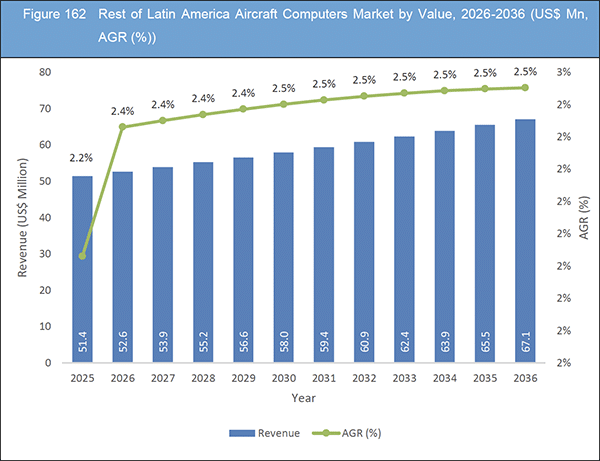
14.12 Rest of Latin America Aircraft Computers Analysis
15 Company Profiles
15.1 Competitive Landscape, 2024
15.2 Strategic Outlook
15.3 Airbus SE
15.3.1 Company Snapshot
15.3.2 Company Overview
15.3.3 Financial Analysis
15.3.3.1 Net Revenue, 2020-2024
15.3.3.2 R&D, 2020-2024
15.3.3.3 Regional Market Shares, 2024
15.3.3.4 Business Segment Market Shares, 2024
15.3.4 Product Benchmarking
15.3.5 Strategic Outlook
15.3.6 SWOT Analysis
15.4 Raytheon Technologies (RTX)
15.4.1 Company Snapshot
15.4.2 Company Overview
15.4.3 Financial Analysis
15.4.3.1 Net Revenue, 2020-2024
15.4.3.2 R&D, 2020-2024
15.4.3.3 Regional Market Shares, 2024
15.4.3.4 Business Segment Market Shares, 2024
15.4.4 Product Benchmarking
15.4.5 Strategic Outlook
15.4.6 SWOT Analysis
15.5 Leonardo SpA
15.5.1 Company Snapshot
15.5.2 Company Overview
15.5.3 Financial Analysis
15.5.3.1 Net Revenue, 2020-2024
15.5.3.2 Regional Market Shares, 2024
15.5.3.3 Business Segment Market Shares, 2024
15.5.4 Product Benchmarking
15.5.5 Strategic Outlook
15.5.6 SWOT Analysis
15.6 Elbit Systems Ltd
15.6.1 Company Snapshot
15.6.2 Company Overview
15.6.3 Financial Analysis
15.6.3.1 Net Revenue, 2020-2024
15.6.3.2 R&D, 2020-2024
15.6.3.3 Regional Market Shares, 2024
15.6.3.4 Business Segment Market Shares, 2024
15.6.4 Product Benchmarking
15.6.5 Strategic Outlook
15.6.6 SWOT Analysis
15.7 Thales SA
15.7.1 Company Snapshot
15.7.2 Company Overview
15.7.3 Financial Analysis
15.7.3.1 Net Revenue, 2020-2024
15.7.3.2 R&D, 2020-2024
15.7.3.3 Regional Market Shares, 2024
15.7.3.4 Business Segment Market Shares, 2024
15.7.4 Product Benchmarking
15.7.5 Strategic Outlook
15.7.6 SWOT Analysis
15.8 Israel Aerospace Industries Ltd. (IAI)
15.8.1 Company Snapshot
15.8.2 Company Overview
15.8.3 Product Benchmarking
15.8.4 Strategic Outlook
15.8.5 SWOT Analysis
15.9 Aviation Industry Corporation of China (AVIC)
15.9.1 Company Snapshot
15.9.2 Company Overview
15.9.3 Product Benchmarking
15.9.4 Strategic Outlook
15.9.5 SWOT Analysis
15.10 GE Aerospace Services
15.10.1 Company Snapshot
15.10.2 Company Overview
15.10.3 Financial Analysis
15.10.3.1 Net Revenue, 2020-2024
15.10.3.2 R&D, 2020-2024
15.10.3.3 Regional Market Shares, 2024
15.10.3.4 Business Segment Market Shares, 2024
15.10.4 Product Benchmarking
15.10.5 Strategic Outlook
15.10.6 SWOT Analysis
15.11 BAE Systems Plc
15.11.1 Company Snapshot
15.11.2 Company Overview
15.11.3 Financial Analysis
15.11.3.1 Net Revenue, 2020-2024
15.11.3.2 R&D, 2020-2024
15.11.3.3 Regional Market Shares, 2024
15.11.3.4 Business Segment Market Shares, 2024
15.11.4 Product Benchmarking
15.11.5 Strategic Outlook
15.11.6 SWOT Analysis
15.12 L3Harris Technologies, Inc
15.12.1 Company Snapshot
15.12.2 Company Overview
15.12.3 Financial Analysis
15.12.3.1 Net Revenue, 2020-2024
15.12.3.2 R&D, 2020-2024
15.12.3.3 Regional Market Shares, 2024
15.12.3.4 Business Segment Market Shares, 2024
15.12.4 Product Benchmarking
15.12.5 Strategic Outlook
15.12.6 SWOT Analysis
15.13 Korea Aerospace Industries (KAI)
15.13.1 Company Snapshot
15.13.2 Company Overview
15.13.3 Financial Analysis
15.13.3.1 Net Revenue, 2020-2024
15.13.3.2 Regional Market Shares, 2024
15.13.3.3 Business Segment Market Shares, 2024
15.13.4 Product Benchmarking
15.13.5 Strategic Outlook
15.13.6 SWOT Analysis
15.14 Denel SOC Ltd.
15.14.1 Company Snapshot
15.14.2 Company Overview
15.14.3 Product Benchmarking
15.14.4 SWOT Analysis
15.15 EDGE Group PJSC
15.15.1 Company Snapshot
15.15.2 Company Overview
15.15.3 Product Benchmarking
15.15.4 Strategic Outlook
15.15.5 SWOT Analysis
15.16 Embraer S.A.
15.16.1 Company Snapshot
15.16.2 Company Overview
15.16.3 Financial Analysis
15.16.3.1 Net Revenue, 2020-2024
15.16.3.2 Regional Market Shares, 2024
15.16.3.3 Business Segment Market Shares, 2024
15.16.4 Product Benchmarking
15.16.5 Strategic Outlook
15.16.6 SWOT Analysis
15.17 Hindustan Aeronautics Limited (HAL)
15.17.1 Company Snapshot
15.17.2 Company Overview
15.17.3 Product Benchmarking
15.17.4 Strategic Outlook
15.17.5 SWOT Analysis
16 Conclusion and Recommendations
16.1 Concluding Remarks from Visiongain
16.2 Recommendations for Market Players
ご注文は、お電話またはWEBから承ります。お見積もりの作成もお気軽にご相談ください。本レポートと同分野(航空)の最新刊レポート
Visiongain社の 航空・海事分野 での最新刊レポート本レポートと同じKEY WORD(aircraft)の最新刊レポート
よくあるご質問Visiongain社はどのような調査会社ですか?英国の調査会社ヴィジョンゲイン社(Visiongain)は、通信とエネルギーのほか、自動車や化学・医薬品、金属など、広範な市場を対象に調査を行っています。自動車市場については、市場全般に関する調査のほ... もっと見る 調査レポートの納品までの日数はどの程度ですか?在庫のあるものは速納となりますが、平均的には 3-4日と見て下さい。
注文の手続きはどのようになっていますか?1)お客様からの御問い合わせをいただきます。
お支払方法の方法はどのようになっていますか?納品と同時にデータリソース社よりお客様へ請求書(必要に応じて納品書も)を発送いたします。
データリソース社はどのような会社ですか?当社は、世界各国の主要調査会社・レポート出版社と提携し、世界各国の市場調査レポートや技術動向レポートなどを日本国内の企業・公官庁及び教育研究機関に提供しております。
|
|